How This Site Evolved: From Vanilla Astro on GitHub Pages to a Token-Driven Monograph at shashinkumar.com
An architectural retrospective on evolving a personal engineering platform: starting with vanilla Astro on GitHub Pages, iterating into a token-driven Engineering Notebook UI with Mermaid v12 and automated gates, and migrating to custom DNS ownership at shashinkumar.com.
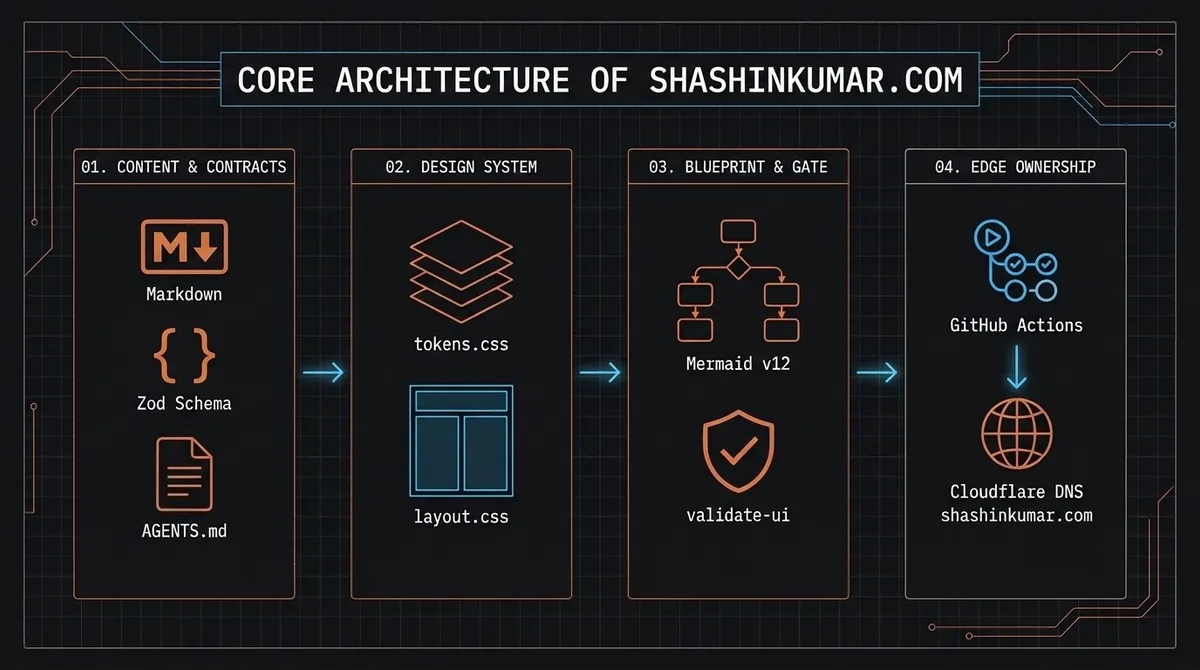
Lineage & Reference Architecture: This note picks up directly where my first post—Why Astro & GitHub Pages for My Architecture Blog—left off, and pairs with the technical system breakdown in Engineering This Monograph.
Most personal engineering sites fail in one of two opposite directions. Either they pull in a heavy Single Page Application stack on Day 1 just to serve Markdown essays—classic premature Blacksmithing—or they freeze on a default starter template where diagrams break across themes, code blocks fail contrast checks, and the site stays tied to a generic subdomain.
When I first stood up kumarshaz.github.io, I didn’t draft a grand multi-phase UI roadmap. I started with the smallest working core, shipped essays, observed where the platform pushed back, and refactored one architectural boundary at a time—following the Lego Framework principle of keeping a rigid skeleton with repairable, swappable joints.
Looking back across that progression—from bare-bones Astro and GitHub Pages, through a token-driven design system and bundled Mermaid v12 engine, to custom DNS ownership at shashinkumar.com—every step emerged from hands-on research and forced a real engineering trade-off.
1. Explore, Learn, and Build: How “Start From Scratch in the AI Era” Emerges Naturally
People often treat “starting from scratch in the AI era” as a formal doctrine or an excuse to prompt an entire bespoke platform into existence in one sitting. In practice, doing that only generates undifferentiated complexity before you even know what your writing or tooling workflow actually demands.
Instead, the pattern shown below isn’t an abstract philosophy imposed up front—it is simply the natural outcome of an explore, learn, and build loop:
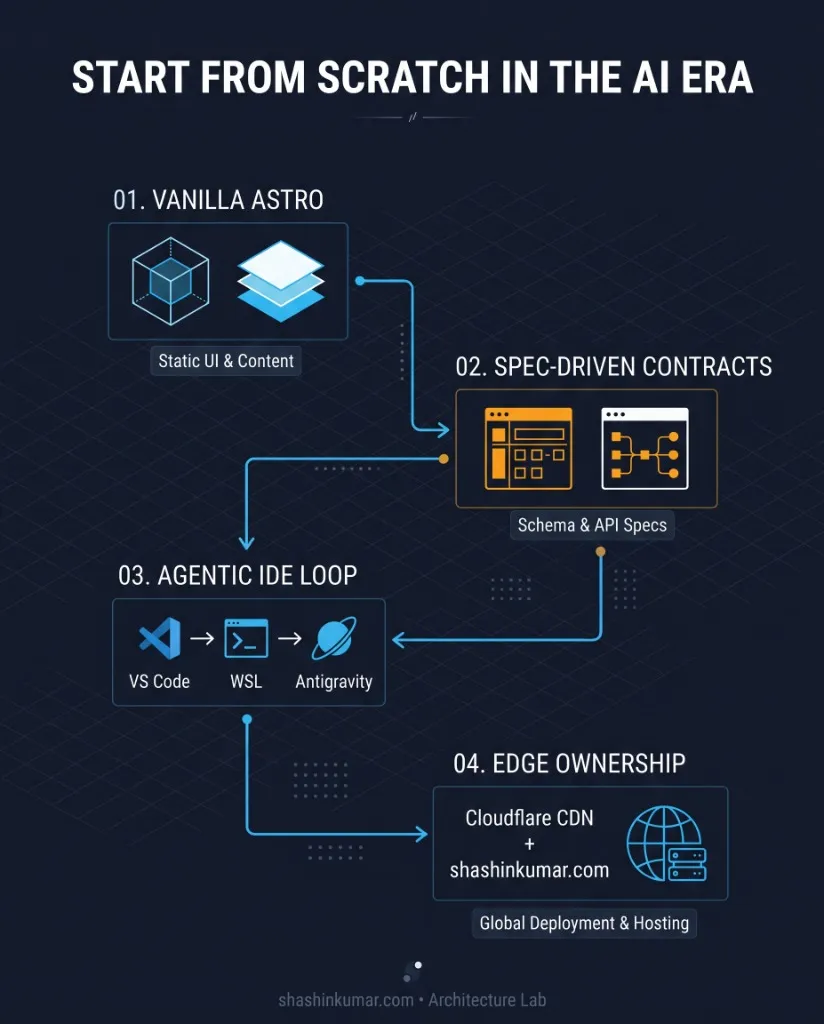
When you explore a minimal toolset, learn directly from real friction, and build only what earns its keep, four functional layers end up reinforcing each other organically:
01. Vanilla Astro(Static UI & Content): You begin by exploring the lightest viable stack—zero-JavaScript static HTML and file-system Markdown—so shipping content takes minutes rather than weeks.02. Spec-Driven Contracts(Schema & API Specs): As content and UI complexity grow, you learn that informal conventions drift fast. Locking Zod schemas (src/content.config.ts), agent charters (AGENTS.md), and automated validation scripts (scripts/validate-ui.mjs) turns expectations into verifiable gates.03. Agentic IDE Loop(VS Code → WSL → Antigravity): With strict contracts in place, human architectural judgment and AI coding agents iterate cleanly inside isolated branches (blogs/{topic-name}), compressing repetitive CSS, layout, and testing cycles without losing structural discipline.04. Edge Ownership(Cloudflare CDN + shashinkumar.com): Once the platform matures into a durable knowledge hub, you outgrow borrowed platform subdomains and take ownership of canonical URLs, DNS routing, TLS behavior, and social metadata at the edge.
None of those layers was over-engineered before its turn. Each step answered a concrete bottleneck uncovered while building the previous one.
2. Phase 1: Vanilla Astro & GitHub Pages — The Baseline
In Why Astro & GitHub Pages for My Architecture Blog, I documented why I started with plain vanilla Astro and GitHub Pages: Island Architecture shipped zero JavaScript by default, Markdown lived cleanly alongside code in Git, and GitHub Actions collapsed version control, builds, and global static hosting into a single free pipeline.
Functionally, that baseline began from the stock Astro blog starter template—complete with Bear Blog CSS (--accent: #2337ff), bundled Atkinson fonts, and placeholder posts. Getting from a stock template to a usable publishing baseline uncovered the first batch of small, practical adjustments:
- CI Runtime Alignment: Astro 6 required Node
>=22.12.0, forcing an explicitnode-version: 22pin insidewithastro/actionin.github/workflows/deploy.ymlalongside workflow runner updates. - Topic Taxonomy Routing: A chronological feed quickly flattens technical essays, so I extended
src/content.config.tswithtagsand added dynamic/blog/tag/[tag]generation to group posts acrossArchitecture,SDLC,AI, andResearch. - Lightweight Mermaid Patch: When visual strategy posts like Why I Love Wardley Mapping needed native diagrams without hand-exporting PNGs, a small
<script type="module">patch inBlogPost.astropulled Mermaid v11 from jsDelivr CDN and switched between'default'and'dark'themes on initial load.
Phase 1 Research & Trade-Offs
| Functional Area | Why It Won Initially | Where Friction Emerged |
|---|---|---|
| Bear Blog Starter Shell | Zero setup friction; instant static speed. | Centered 720px shadow cards looked like a hobby template rather than a crisp engineering specification. |
| jsDelivr CDN Mermaid | Zero npm dependencies in package.json. | Tied builds to external CDN availability, broke live Dark/Light toggling without page reloads, and lacked advanced layout engines (ELK / Tidy-Tree). |
| Minimal Frontmatter | Fast manual publishing for initial essays. | Lacked category filters, document identifiers (docId), and automated regression checks for broken links or theme contrast. |
The takeaway from Phase 1 was pragmatic: a starter template validates the publishing habit cheaply, but visual authority and diagram fidelity require intentional architecture once your catalog scales.
3. Phase 2: Token-Driven Design System, Foundry & Mermaid v12
As the site expanded into deeper architecture notes and companion software tools, ad-hoc template styling could no longer hold the system together. Rather than adopting React or a heavy component framework, I refactored the frontend around a pure CSS Token-Driven Editorial Design System backed by automated build verification.
Getting the visual system right wasn’t a single leap—it evolved through rapid explore-and-refine passes:
A. Converging on the “Engineering Notebook” Aesthetic
- Three-Tier Token Architecture (
src/styles/tokens.css): Separated raw color/font primitives (Tier 1), semantic surface and rule variables like--bg-canvas,--bg-surface,--text-primary, and--border-strong(Tier 2), and diagram variables like--mermaid-node-bg,--mermaid-node-border, and--mermaid-line(Tier 3) so HTML prose, layout grids, and rendered diagrams share a single source of truth. - Pruning Decorative Clutter: Early styling drafts experimented with boxed outer wireframe borders, serif display headlines (
Newsreader), indigo accents, and pseudo-code labels (MONOGRAPH //,DOM-01). Inspecting real rendered pages exposed those prefixes as visual noise, leading to an immediate cleanup. - Open Layout & Technical Typography (
Option D): The site converged on an open1120pxEngineering Notebook grid (src/styles/layout.css) anchored by2pxhorizontal rules, a240pxsticky metadata/TOC rail alongside a76chprose column, SIL OFL 1.1 open-source fonts (Space Mono,IBM Plex Sans,IBM Plex Mono), and calibrated Engineering Paper & Signal Rust (Light) / Anvil Carbon & Signal Amber (Dark) palettes. - Dual-Theme Code Readability & Taxonomy Polish: Switching to a warm light paper canvas exposed low-contrast code blocks, solved by configuring Shiki dual themes (
github-light/github-dark) inastro.config.mjsand synchronizing them via[data-theme="dark"]selectors insrc/styles/global.css. Category filters in/blogwere standardized around Essays, Practitioner Notes, and Research with populated badge counts.
B. Separating “What I Write” from “What I Build” (/foundry)
As reusable architecture toolkits (Atruss Code Atlas, TDD Analyzer, To-Markdown Converter, and the monograph platform itself) matured alongside essays, mixing product specs into the blog feed blurred two distinct intents. Adding a second Zod-validated foundry collection in src/content.config.ts introduced structured repository and live-demo metadata (repoUrl, liveUrl)—rendering Product UI ↗ and GitHub Repo ↗ action pills in the sticky rail and surfacing What I Write About alongside What I Build on the homepage.
C. Re-Architecting the Mermaid Blueprint Pipeline
To eliminate CDN fragility and inconsistent diagram rendering, the Mermaid integration in BlogPost.astro was rebuilt from a 39-line CDN script into a bundled, interactive blueprint engine:
---
config:
  layout: elk
  flowchart:
    diagramPadding: 20
    nodeSpacing: 28
    rankSpacing: 48
    subGraphTitleMargin:
      top: 12
      bottom: 18
---
flowchart TB
    %% title: Evolution of the Site Architecture & Validation Pipeline
    subgraph Stage1["1. Vanilla Baseline"]
        direction LR
        B1["Bear Blog Starter CSS\nZero-JS Static HTML"]:::intakeNode
        B2["CDN Mermaid v11\nBasic Theme Switch"]:::warnNode
        B1 e1@==> B2
    end

    subgraph Stage2["2. Engineering Notebook UI"]
        direction LR
        D1["3-Tier CSS Tokens\nPaper/Rust vs Carbon/Amber"]:::codeNode
        D2["Asymmetric Grid + Shiki\nSticky Rail + Dual Themes"]:::codeNode
        D1 e2@==> D2
    end

    subgraph Stage3["3. Mermaid v12 Blueprint Engine"]
        direction LR
        M1["Bundled ELK + Tidy-Tree\nUniform Subgraph Pass"]:::gateNode
        M2["Lightbox & Exporter\nSVG/PNG + Watermark"]:::gateNode
        M1 e3@==> M2
    end

    subgraph Stage4["4. Contracts & Edge Ownership"]
        direction LR
        G1["AGENTS.md + validate-ui\nAutomated Build Gates"]:::safeNode
        G2["Cloudflare DNS + CNAME\nshashinkumar.com + OG Card"]:::safeNode
        G1 e4@==> G2
    end

    Stage1 e5@==>|"Design System Overhaul"| Stage2
    Stage2 e6@==>|"Live CSS Var Sync"| Stage3
    Stage3 e7@==>|"Zero-Error Gate + Edge Switch"| Stage4

    e1@{ animate: true }
    e2@{ animate: true }
    e3@{ animate: true }
    e4@{ animate: true }
    e5@{ animate: true }
    e6@{ animate: true }
    e7@{ animate: true }

    classDef intakeNode fill:#1E293B,stroke:#38BDF8,stroke-width:2px,color:#F8FAFC
    classDef warnNode fill:#FFFBEB,stroke:#D97706,stroke-width:2px,color:#111111
    classDef codeNode fill:#EFF6FF,stroke:#2563EB,stroke-width:2px,color:#1E3A8A
    classDef gateNode fill:#F5F3FF,stroke:#7C3AED,stroke-width:2px,color:#4C1D95
classDef safeNode fill:#ECFDF5,stroke:#059669,stroke-width:2.5px,color:#064E3B- Bundled Multi-Engine Layouts: Replaced the jsDelivr import with bundled
mermaid,@mermaid-js/layout-elk, and@mermaid-js/layout-tidy-tree. Flowcharts opt intolayout: elk, while mindmaps uselayout: tidy-tree(enforced both at runtime inBlogPost.astroand at build time inscripts/validate-ui.mjs). - Live Theme Synchronization: Toggling Light/Dark mode in
Header.astrodispatches atheme-changeevent, promptingBlogPost.astroto re-read active CSS tokens and re-render Mermaid SVGs in place without reloading the page. - Uniform Subgraph Sizing: Native ELK renders sibling boxes at uneven widths proportional to text length. Wrapping ELK’s layout renderer in a two-pass probe (
createUniformSubgraphRender) measures natural label dimensions and equalizes sibling nodes inside each subgraph so boxes align cleanly. - Interactive Inspection & Portable Exports: Wrapped every diagram in a
.mermaid-blueprintframe featuring zoom controls, fullscreen lightbox expansion, heading-resolved titles (resolveDiagramTitle), theme-aware copyright footers, and standalone SVG / high-DPI PNG downloads with embedded surface backgrounds. - Executable Governance (
AGENTS.md+scripts/validate-ui.mjs): Codified branching rules (blogs/*), Zod schema contracts, and hundreds of automated checks verifying token completeness, layout primitives, internal link integrity, and taxonomy badge counts on every build.
D. The Skeptic’s Audit of the Design System
Keeping third-party UI libraries out preserved static simplicity on landing and index pages, yet it did not magically erase complexity—it relocated it:
- Concentrated Layout Script: Supporting two-pass ELK sizing, theme re-rendering, SVG serialization, PNG rasterization, and lightbox accessibility pushed
src/layouts/BlogPost.astropast1,400lines of specialized client TypeScript. - Scoped Bundle Weight: Bundling Mermaid and ELK guarantees deterministic offline rendering at the cost of a heavier JavaScript payload specifically on article routes containing diagrams, while index and home routes stay lean.
- Migration Residue:
src/components/BaseHead.astrostill carries legacy Google Fonts families alongsideSpace MonoandIBM Plexto satisfy early automated assertions inscripts/validate-ui.mjs—a practical reminder that validation gates lock in backward compatibility until you refactor both the implementation and the gate contract together.
4. Phase 3: Custom DNS, Cloudflare & Edge Ownership
Even with a cohesive design system and automated validation suite, canonical URLs, RSS feeds, sitemaps, diagram watermarks, and social previews still pointed to kumarshaz.github.io—and link previews fell back to Astro’s stock placeholder graphic.
Graduating to shashinkumar.com unified the site’s external identity with its internal engineering rigor:
// astro.config.mjs — canonical origin anchored to custom domain
export default defineConfig({
	site: 'https://shashinkumar.com',
	integrations: [mdx(), sitemap()],
	markdown: {
		shikiConfig: {
			themes: {
				light: 'github-light',
				dark: 'github-dark',
			},
		},
	},
});
Alongside updating astro.config.mjs and adding public/CNAME, the migration updated diagram copyright watermarks, Foundry liveUrl references, and scripts/validate-ui.mjs checks to confirm dist/CNAME, rel="canonical", rss.xml, and sitemap-index.xml emit zero residual kumarshaz.github.io feed links. Replacing the stock Open Graph fallback in BaseHead.astro with a branded public/og-default.png card completed the visual identity across link shares.
The DNS, TLS & Portability Trade-Offs
Pointing a custom domain through Cloudflare DNS in front of GitHub Pages looks deceptively simple in Git, yet three architectural trade-offs determine whether it runs reliably:
- Vendor Decoupling (Substitutivity) vs. Zero-Config Simplicity:
- Trade-off: Staying on
kumarshaz.github.ioeliminates domain renewals and DNS configuration overhead. Adoptingshashinkumar.comtakes on DNS management in exchange for canonical host portability—allowing static hosting to move from GitHub Pages to Cloudflare Pages, object storage, or self-hosted edges in the future without breaking RSS subscribers, search indexing, or external backlinks.
- Trade-off: Staying on
- Apex Routing (
CNAMEFlattening vs. StaticARecords):- Technical constraint: Standard DNS rules disallow a bare
CNAMEat a zone apex (shashinkumar.comwithoutwww.) because it conflicts withSOA/NSrecords, forcing many registrars into hardcodedArecords pointing at GitHub Pages IPs. Routing through Cloudflare DNS enables native CNAME flattening at the apex alongside edge caching, redirect rules, and response header control.
- Technical constraint: Standard DNS rules disallow a bare
- TLS Termination & Multi-Repo Blast Radius:
- Proxy & ACME Alignment: Enabling Cloudflare’s edge proxy before GitHub Pages finishes Let’s Encrypt validation—or mismatching
FlexibleSSL against GitHub’s HTTPS enforcement—produces redirect loops (ERR_TOO_MANY_REDIRECTS) or broken certificate renewals. Aligning Cloudflare toFull (Strict)(once origin TLS is verified) eliminates split-brain TLS behavior. - Sibling Project Sub-Path Coupling: Because
kumarshaz.github.iois a GitHub user-level repository, attachingshashinkumar.comviaCNAMEautomatically re-roots sibling GitHub Pages project sites under the same account onto sub-paths (such ashttps://shashinkumar.com/atruss-code-atlas/). Root DNS changes therefore carry multi-repository URL coupling across linked Foundry live portals.
- Proxy & ACME Alignment: Enabling Cloudflare’s edge proxy before GitHub Pages finishes Let’s Encrypt validation—or mismatching
5. Summary of Architectural & Functional Trade-Offs
| Functional Layer | Research Trigger / Friction | Architectural Decision | Explicit Trade-Off Accepted |
|---|---|---|---|
| Vanilla Astro Core | Needed zero-JS, Git-native authoring without CMS or server maintenance. | Astro static generation + Markdown collections on GitHub Pages. | Accepted starter aesthetics on Day 1 to prioritize shipping. |
| CI & Taxonomy Routing | Default Node runners lagged Astro requirements; flat feeds hid topics. | Pinned Node 22 in GitHub Actions + dynamic /blog/tag/[tag] routes. | Coupled CI config to Node LTS cadence and static tag route fan-out. |
| Token-Driven Design System | Starter cards lacked executive clarity; light paper broke dark code blocks. | 3-tier tokens.css, Option D layout.css, Space Mono/IBM Plex, dual-theme Shiki. | Preserved legacy font links briefly to keep backward validation gates green. |
| Foundry Collection | Built tools (Atruss Code Atlas, TDD Analyzer) needed code/live metadata. | Separate foundry schema (repoUrl, liveUrl) surfaced alongside /blog. | Dual collection schema and tag synchronization across /blog and /foundry. |
| Mermaid v12 Blueprint Engine | CDN Mermaid failed offline builds, live theme swaps, and uniform box alignment. | Bundled ELK + Tidy-Tree, pre-ELK uniform sizing, lightbox, watermarked SVG/PNG export. | Higher client TS complexity in BlogPost.astro and heavier diagram-page JS. |
| Executable Governance | Agentic and manual edits risk silent layout, link, and schema regressions. | AGENTS.md branch/schema rules + scripts/validate-ui.mjs build gate. | Every feature requires maintaining matching validation assertions. |
| Custom DNS & Social Identity | Platform subdomain coupled brand equity to GitHub and stock social cards. | public/CNAME (shashinkumar.com), Cloudflare DNS, canonical Astro.site, og-default.png. | Apex TLS/proxy alignment and sub-path coupling across sibling project sites. |
---
config:
  layout: tidy-tree
---
mindmap
  root(("Site Evolution Trade-Offs"))
    ("1. Vanilla Astro Core")
      ("Zero-JS Static HTML")
      ("Markdown + Git Co-Location")
      ("Deferred Visual Polish")
    ("2. Engineering Notebook UI")
      ("3-Tier CSS Tokens")
      ("Open Horizontal Grid + SIL OFL Fonts")
      ("Shiki Dual-Theme Contrast")
    ("3. Bundled Blueprint Engine")
      ("Mermaid v12 + ELK + Tidy-Tree")
      ("Pre-ELK Uniform Subgraph Sizing")
      ("SVG/PNG Watermarked Exporter")
    ("4. Contracts & Edge Ownership")
      ("Zod Schema + AGENTS.md + UI Gate")
      ("Cloudflare DNS + public/CNAME")
      ("shashinkumar.com + og-default.png")
6. Repairable Anatomy in Practice
The real lesson across this site’s evolution comes down to sequencing.
Had I tried to architect a three-tier token system, write a two-pass ELK subgraph equalizer, maintain an automated UI test harness, and configure Cloudflare apex flattening before publishing my first post, the site would have stalled under self-inflicted complexity. Conversely, stopping at the starter template would have left visual presentation, diagram reliability, and domain identity lagging behind the technical depth of the articles.
By letting each stage emerge from an explore, learn, and build cycle anchored by swappable boundaries:
- Replacing the Bear Blog shell with the Engineering Notebook design system never required rewriting existing Markdown posts.
- Upgrading from CDN Mermaid v11 to bundled Mermaid v12 with ELK, Tidy-Tree, uniform subgraphs, and SVG/PNG exports preserved every existing fenced diagram intact.
- Moving canonical identity from
kumarshaz.github.iotoshashinkumar.comtook aCNAMEdeclaration, a singlesiteorigin update, a branded social card, and an automated gate verifying canonical tags, RSS, and sitemaps migrated in lockstep.
Start light enough that you ship. Lock contracts once patterns repeat. Verify invariants mechanically in your build pipeline. And claim edge ownership once your publishing foundation is ready to outlive any single host.