Why Astro & GitHub Pages for My Architecture Blog
An architectural deep-dive into the pragmatic selection of Astro and GitHub Pages for a blazing-fast, content-driven personal portfolio.
As a Product Architect, my mission is to transition engineering cultures from “Master Blacksmiths”—relying on manual, effort-based labor—to “Master Goldsmiths,” where we focus on high-precision logic to handle business uncertainty.
When it came time to build my personal branding and architecture blog, I applied this exact philosophy. I needed a technology stack that avoided unnecessary complexity, honored the “Lego Framework” of composability, and prioritized a seamless Developer Experience (DevEx). The winning combination? Astro for the frontend and GitHub Pages for the deployment.
Here is an architectural breakdown of what these platforms are, and why they were chosen over the sea of alternatives.
What is Astro?
Astro is a modern web framework designed specifically for building fast, content-driven websites like blogs, portfolios, and documentation.
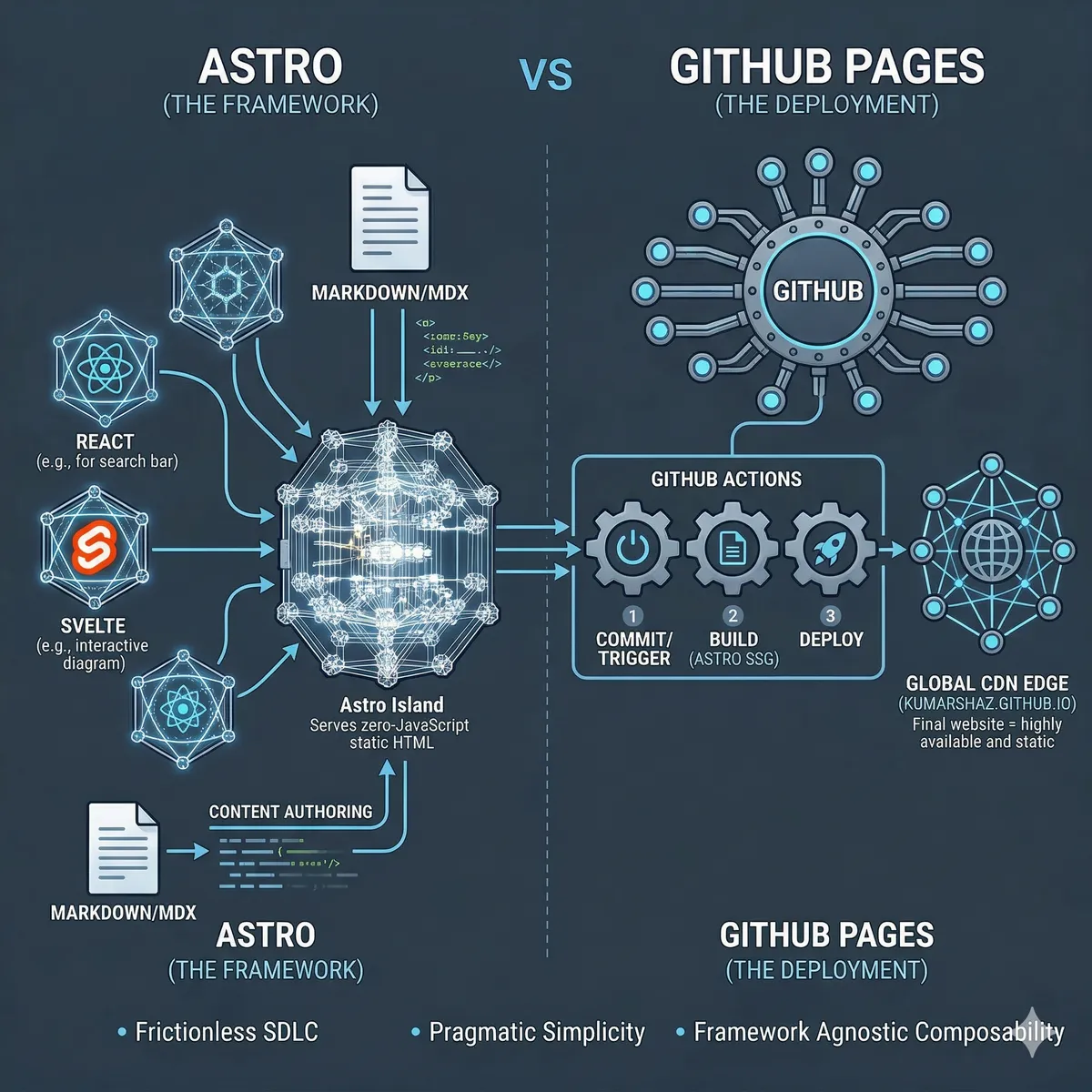
Unlike massive Single Page Application (SPA) frameworks that ship heavy JavaScript bundles to the browser, Astro operates on a paradigm called Island Architecture. By default, Astro generates zero-JavaScript static HTML. If you need an interactive component (like a React-based search bar or an interactive diagram), Astro allows you to embed that specific “island” of interactivity while keeping the rest of the page completely static.
What is GitHub Pages?
GitHub Pages is a seamless static site hosting service. It takes HTML, CSS, and JavaScript files straight from a repository on GitHub, optionally runs them through a build process, and publishes a website.
It acts as both the version control system and the highly-available CDN edge network, eliminating the need to tie external platforms or complex cloud infrastructure (like AWS S3 + CloudFront) to your publishing pipeline.
Why Astro? (The Architectural Perspective)
1. The “Lego Framework” Composability
Astro is framework-agnostic. While I architect bespoke .NET and React applications in the enterprise, building a blog strictly in React (via Next.js) introduces unnecessary rendering overhead. Astro gave me the “Lego” capability: I can write a 100% static blog, but if I need an complex interactive visualization, I can seamlessly plug a React or Svelte component directly into the Astro page. It perfectly aligns with designing repairable, easily swappable architecture.
2. High-Precision Performance (Master Goldsmiths)
Master Goldsmithing is about precision. Astro surgically removes everything the browser doesn’t need to render text. By shipping zero JavaScript by default, the Time to Interactive (TTI) and First Contentful Paint (FCP) metrics are absolutely pristine.
3. Frictionless Content Authoring
Astro treats Markdown and MDX as first-class citizens. For a blog focused heavily on dense architectural concepts, diagrams, and structured lists, I do not want to fight with a CMS database or rich-text editors. Content is written in Markdown alongside the code, perfectly adhering to Spec-Driven Development (SDD) principles.
Why GitHub Pages? (The SDLC Perspective)
1. Unified SDLC & CI/CD Readiness
In the enterprise, fragmented tooling is a massive productivity killer. By leveraging GitHub Pages and GitHub Actions, my entire Software Development Life Cycle (SDLC) lives in one dashboard. Every time I write a new blog post and commit the Markdown file, a GitHub Action automatically builds the Astro site and deploys it. It’s automated precision over manual toil.
2. Growing a Meaningful Portfolio
A major goal of this project is to build a track record of meaningful code check-ins. By hosting the blog directly on my primary GitHub account (kumarshaz.github.io), my architectural thoughts and the code that powers them are inherently bound together. Anyone reading my concepts can instantly inspect the exact commits that deployed them.
3. Pragmatic Cost vs. Value
We have access to incredible enterprise tools (Azure, multi-cloud Kubernetes, Confluent Kafka), but valuing simplicity over complexity is a core pillar of good architecture. GitHub Pages provides a secure, highly-available, globally distributed edge network for an SSG (Static Site Generator) at zero cost. It is the most pragmatic choice for personal knowledge sharing.
Conclusion
Choosing Astro and GitHub Pages wasn’t just about picking popular tools; it was about selecting the right operational model. The stack is modular, entirely transparent, incredibly fast, and treats the Developer Experience with immense respect.
It is a true “Lego” architecture—ready to be built upon, iteration after iteration.