Engineering This Monograph: A Token-Driven Astro & Mermaid Architecture
How this personal architecture platform is engineered as a zero-JS-by-default Engineering Notebook using a 3-tier CSS token system, Token-Synced Mermaid v12 blueprints, and an automated 260+ check validation gate.
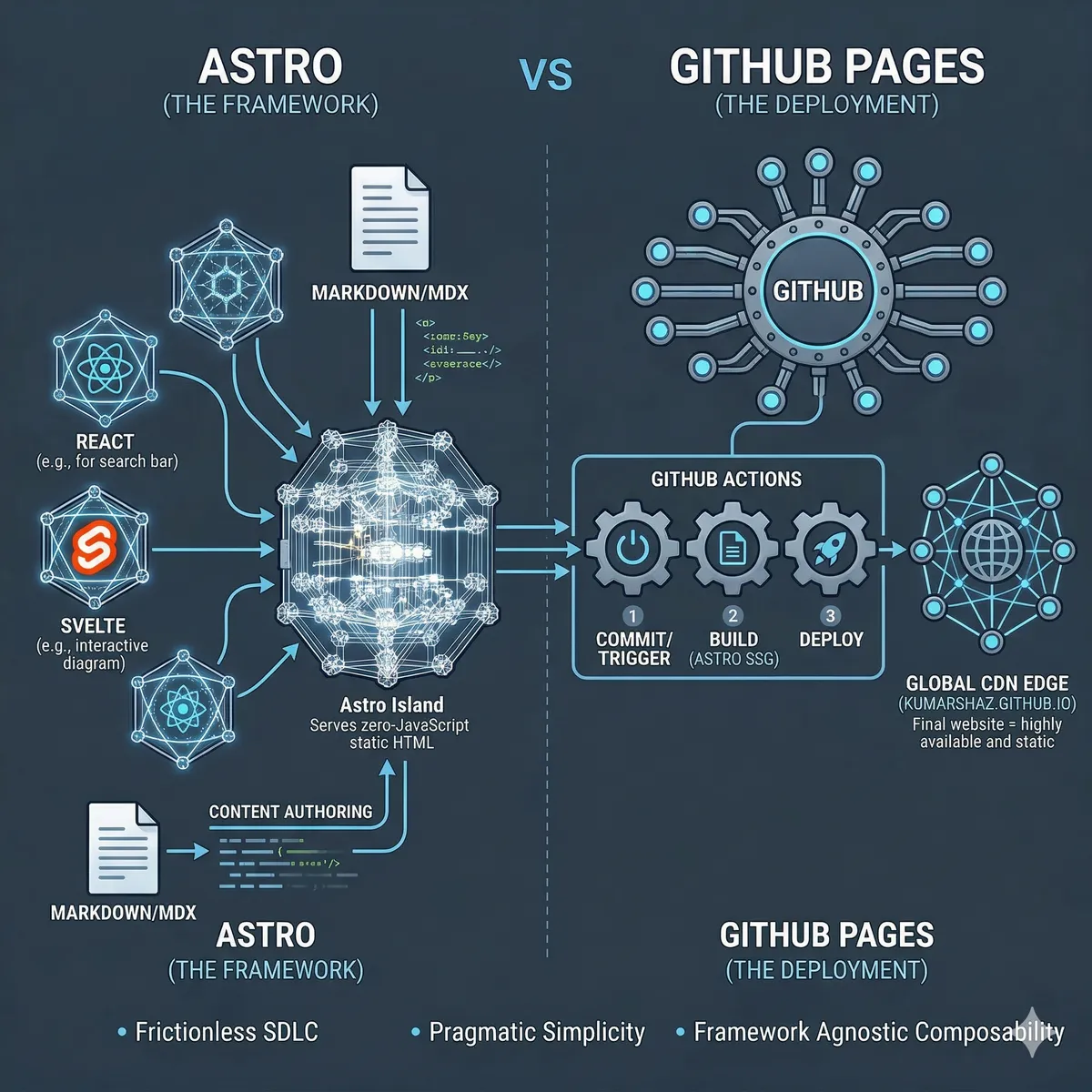
When writing about enterprise composability, domain autonomy, and socio-technical systems, the user interface itself should reflect architectural rigor. Rather than relying on a generic starter template or pulling in a heavy client-side component library that fights a pure Markdown workflow, I engineered this website as a Token-Driven Editorial Design System—anchored in an open Engineering Notebook aesthetic.
1. The Architectural Problem: Escaping the Hobbyist Template
Most developer blogs fall into one of two traps:
- The Un-Gridded Starter Template: Centered columns with soft floating cards and mismatched diagram colors that lack executive technical authority.
- The Over-Engineered SPA: Heavy React component libraries and client-side state machines shipped just to render static prose and SVG diagrams.
Following my Master Goldsmith philosophy and the Lego Framework, I designed this platform around a strict separation of concerns: zero client-side JavaScript by default, pure Markdown + Mermaid authoring, and a single CSS token source of truth shared across typography, layout rails, syntax highlighting, and architectural diagrams.
---
config:
  layout: elk
---
flowchart TB
    %% title: Monograph Token, Layout & Governance Pipeline
    classDef token fill:#FFFBEB,stroke:#D97706,stroke-width:2px,color:#78350F
    classDef layout fill:#EFF6FF,stroke:#2563EB,stroke-width:2px,color:#1E3A8A
    classDef gate fill:#ECFDF5,stroke:#059669,stroke-width:2px,color:#064E3B

    subgraph Layer1["1. Token Foundation (CSS)"]
        PT["Primitive Tokens<br/>(Paper, Carbon, Rust, Amber)"]:::token
        ST["Semantic Surface Tokens<br/>(--bg-canvas, --border-strong)"]:::token
        MT["Mermaid Diagram Tokens<br/>(--mermaid-node-bg, --mermaid-line)"]:::token
        PT e1@--> ST
        PT e2@--> MT
    end

    subgraph Layer2["2. Astro Layout Primitives"]
        NB["Engineering Notebook Layout<br/>(Asymmetric Rail + 72ch Stream)"]:::layout
        SH["Shiki Dual-Theme Engine<br/>(github-light / github-dark)"]:::layout
        ST e3@--> NB
        ST e4@--> SH
    end

    subgraph Layer3["3. Content & Governance Pipeline"]
        MD["Markdown (.md)<br/>+ Mermaid v12 Blocks"]:::layout
        MF["Blueprint Figure Wrapper<br/>(.mermaid-blueprint + ELK / Tidy-Tree)"]:::gate
        VG["Automated UI & Link Validator<br/>(scripts/validate-ui.mjs)"]:::gate
        MD e5@--> MF
        MT [email protected]>|"Dynamic CSS Variable Sync"| MF
        NB e7@--> VG
        SH --> VG
        MF e8@--> VG
    end

    e1@{ animate: true }
    e3@{ animate: true }
    e5@{ animate: true }
    e6@{ animate: true }
    e8@{ animate: true }
2. Three-Tier Design Token Architecture
Instead of scattering hex codes across components, src/styles/tokens.css enforces a three-tier token hierarchy:
- Tier 1 — Primitives: Raw archival paper tones (
#F2F1EC,#E7E5DD), deep anvil carbon (#111214,#181A1E), and high-contrast signal accents (#C84B20Signal Rust for Light Mode;#E87A48Signal Amber for Dark Mode). - Tier 2 — Semantic Surfaces & Rules: Context-aware tokens (
--bg-canvas,--bg-surface,--text-primary,--border-grid,--border-strong) that switch instantaneously when[data-theme="dark"]is toggled. - Tier 3 — Mermaid Diagram Tokens: Dedicated diagram primitives (
--mermaid-node-bg,--mermaid-node-border,--mermaid-line,--mermaid-cluster-bg) consumed at runtime by Mermaid v12.
Open-Source Technical Typography
Every typographic role is mapped to open-source fonts licensed under the SIL Open Font License 1.1:
- Display & Mastheads (
--font-display):Space Monofor unmistakable RFC/specification authority. - Long-Form Editorial Prose (
--font-sans):IBM Plex Sansfor effortless readability across 72-character lines. - Metadata Rails, Code & Diagrams (
--font-mono):IBM Plex Monofor tabular alignment, taxonomy badges, and SVG node labels.
3. Token-Synced Mermaid v12 Blueprint Pipeline (ELK & Tidy-Tree)
Mermaid diagrams often look disconnected from the host site because Mermaid injects isolated default stylesheets. In this platform’s BlogPost.astro layout:
- Zero-Friction Authoring: Diagrams are authored as standard
```mermaidfenced blocks inside Markdown. - Blueprint Figure Framing: At load time, each Mermaid block is wrapped in a
.mermaid-blueprintfigure container featuring a radial dot-matrix technical background, a descriptive header bar resolved from diagram metadata, an SVG/PNG exporter + zoom toolbar with copyright watermarking, and an interactiveExpand/Collapselightbox toggle. - Live Theme Synchronization & Multi-Engine Layout: Mermaid v12 is bundled with
@mermaid-js/layout-elkand@mermaid-js/layout-tidy-tree, initialized withtheme: 'base', and reads active CSS variables viagetComputedStyle(document.documentElement). Flowcharts opt intolayout: elkand mindmaps opt intolayout: tidy-treevia diagram frontmatter (with runtime fallback inBlogPost.astro), while sequences and timelines render sequentially with monotonic SVG IDs. Listening to the customtheme-changeevent re-renders diagrams seamlessly whenever the reader switches between Light and Dark mode.
4. Agentic Authoring & The Automated Validation Gate
True Spec-Driven Development (SDD) means both human architects and AI coding agents operate under explicit, machine-verifiable contracts:
- Operational Agent Charter (
AGENTS.md): Defines how local and remote AI agents branch (blogs/{topic-name}), enforce the Zod content schema (src/content.config.ts), and apply visual Mermaid diagramming skills. - Automated Conformance Gate (
scripts/validate-ui.mjs): Every build executesnpm run check, auditing 4 quality gates across all generated static routes:- Gate 1: 3-Tier CSS token completeness (
tokens.css). - Gate 2: Layout & blueprint container invariants (
layout.css). - Gate 3: Zod schema integrity across
blogandfoundrycollections. - Gate 4: Static HTML route verification, zero broken internal links, accessibility landmarks (
skip-link,#main-content), Shiki dual-theme contrast, and populated taxonomy badge counts.
- Gate 1: 3-Tier CSS token completeness (