To-Markdown Converter: Catch-All Liberation for Visio, Draw.io & MS Office Formats
A catch-all document and diagram ingestion tool that parses Visio (.vsdx) and Draw.io (.drawio/.xml) graphs into deterministic Mermaid Markdown while orchestrating Microsoft MarkItDown across Word, PowerPoint, Excel, and PDFs.
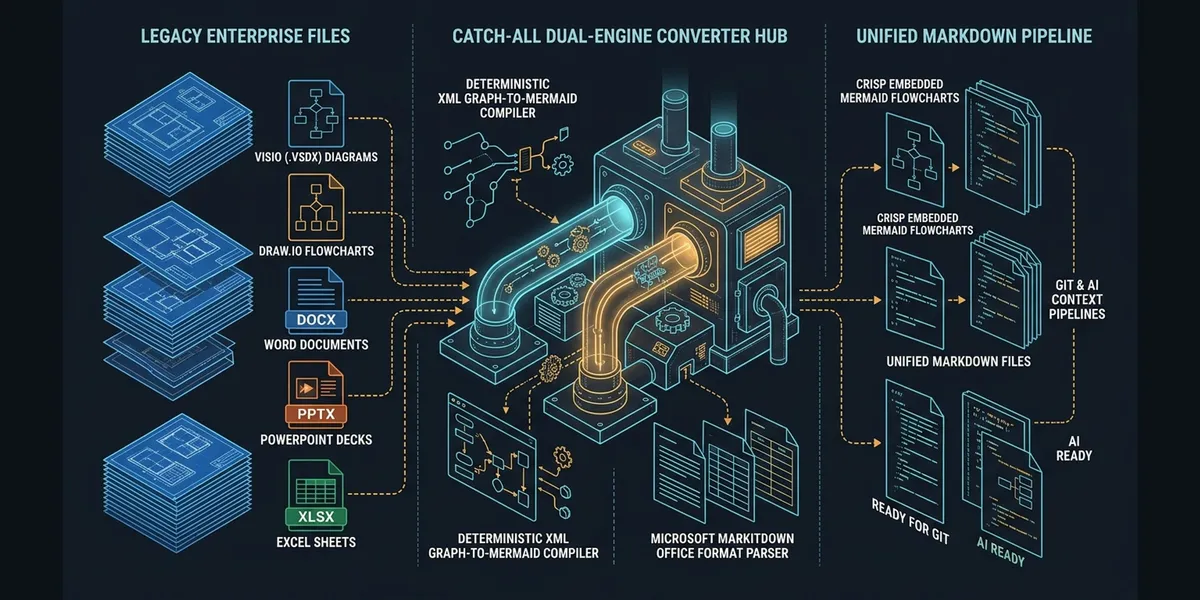
Across large enterprises, critical institutional architecture knowledge is trapped inside proprietary binary and XML containers on SharePoint drives and local project folders: Microsoft Visio (.vsdx) topologies, Draw.io (.drawio / .xml) integration flows, MS Word (.docx) functional designs, PowerPoint (.pptx) ARB decks, and Excel (.xlsx) interface inventories.
These formats share a fatal flaw for modern engineering teams and AI coding agents: they cannot be cleanly diffed in Pull Requests, indexed cleanly in Git repositories, or consumed efficiently by LLM context windows.
I built the To-Markdown Converter as a catch-all unified ingestion pipeline—combining deterministic XML diagram extraction for Visio and Draw.io directly into Mermaid syntax alongside Microsoft MarkItDown orchestration for MS Office documents and rich business attachments.
1. Why a Single Catch-All Pipeline Beats Fragmented Converters
In real-world enterprise modernization, an architecture deliverable is rarely just a diagram or just a document—it arrives as an interconnected bundle of Visio network maps, Draw.io sequence charts, Word Technical Design Documents, and Excel field mappings.
Treating text documents and structural diagrams separately creates brittle glue scripts and fractured context. Instead, the To-Markdown Converter uses a unified dispatch router that inspects file formats and routes each input to the highest-fidelity deterministic parser:
---
config:
  layout: elk
---
flowchart TB
    %% title: Unified Diagram & Document Ingestion Router
    classDef legacy fill:#FEF2F2,stroke:#DC2626,stroke-width:2px,color:#7F1D1D
    classDef router fill:#FFFBEB,stroke:#D97706,stroke-width:2px,color:#78350F
    classDef engine fill:#EFF6FF,stroke:#2563EB,stroke-width:2px,color:#1E3A8A
    classDef out fill:#ECFDF5,stroke:#059669,stroke-width:2px,color:#064E3B

    subgraph Inputs["Legacy Enterprise Inputs"]
        VSDX["Microsoft Visio<br/>(.vsdx OPC Packages)"]:::legacy
        DRAWIO["Draw.io Diagrams<br/>(.drawio / .xml mxGraph)"]:::legacy
        OFFICE["MS Office & Docs<br/>(.docx, .pptx, .xlsx, .pdf, .html)"]:::legacy
    end

    Router{"Catch-All Format<br/>Dispatch Router"}:::router

    subgraph DiagramEngine["Engine A: Deterministic Diagram-to-Mermaid Compiler"]
        OPC["Visio OPC XML Extractor<br/>(pages, Masters, Shapes & Connects)"]:::engine
        MX["Draw.io mxGraph Parser<br/>(Deflate/Base64 Decompress + mxCell)"]:::engine
        AST["Canonical Intermediate Graph<br/>(Nodes, Directed Edges, Groups/Swimlanes)"]:::engine
        MMD["Mermaid Syntax Synthesizer<br/>(flowchart / sequenceDiagram / subgraphs)"]:::engine
    end

    subgraph OfficeEngine["Engine B: Microsoft MarkItDown Pipeline"]
        MIT["Microsoft markitdown Engine<br/>(Headings, Tables, Lists, Slide Notes)"]:::engine
        CLEAN["Structural Markdown Normalizer<br/>(Frontmatter & Asset Links)"]:::engine
    end

    GitOut["Git-Ready Markdown (.md)<br/>Versioned Docs + Embedded Mermaid"]:::out

    VSDX e1@--> Router
    DRAWIO e2@--> Router
    OFFICE e3@--> Router

    Router -->|".vsdx"| OPC
    Router -->|".drawio / .xml"| MX
    Router -->|".docx / .pptx / .xlsx / .pdf"| MIT

    OPC e4@--> AST
    MX e5@--> AST
    AST e6@--> MMD
    MMD e7@--> GitOut

    MIT e8@--> CLEAN
    CLEAN e9@--> GitOut

    e1@{ animate: true }
    e2@{ animate: true }
    e3@{ animate: true }
    e4@{ animate: true }
    e5@{ animate: true }
    e6@{ animate: true }
    e7@{ animate: true }
    e8@{ animate: true }
    e9@{ animate: true }
2. Engine A: Deterministic Diagram Extraction (Visio & Draw.io → Mermaid)
Visual diagrams are graphs—not bitmap pixels. Running OCR or vision-only LLMs over exported PNGs guesses edge directions and hallucinates overlapping labels. Engine A reads the authoritative XML geometry and topological glue records natively.
Microsoft Visio (.vsdx) Extraction
A .vsdx file is an Open Packaging Conventions (OPC) ZIP archive containing structured XML parts:
- Master & Page Resolution: Reads
visio/masters/masters.xmlandvisio/pages/page*.xmlso inherited stencil semantics (decisions, databases, terminators, containers) stay intact even when shapes override only coordinates or text. - Explicit Edge Binding via
<Connect>: Instead of inferring arrows from pixel proximity,<Connect>records bindFromSheet(connector) explicitly toToSheet(source and targetShapeIDs), preserving exact graph causality. - Container & Swimlane Mapping: Bounded container relationships map cleanly into Mermaid
subgraphclusters, separating system boundaries and responsibility lanes.
Draw.io (.drawio / .xml) Extraction
Draw.io files embed mxGraphModel trees inside <diagram> elements—either as plain XML or zlib/Deflate-compressed Base64 payloads:
- Payload Normalization: Automatically detects URL-encoded + Deflate + Base64 compressed
<diagram>payloads versus raw uncompressed<mxGraphModel>XML trees across single-page and multi-page files. - Vertex, Edge & Group Hierarchy (
<mxCell>): Distinguishes vertices (vertex="1"), directional connectors (edge="1"withsource/targetreferences), and nested containers (parent="<group_id>") so hierarchical subgraphs mirror the visual canvas without flattening architecture layers. - Mermaid Compilation: Emits readable, node-normalized Mermaid (
flowchart/sequenceDiagram) using quoted labels (A["Service (REST)"]) so parenthetical metadata never triggers parser errors.
3. Engine B: MS Office & Multi-Format Conversion via Microsoft MarkItDown
For non-diagram enterprise documents—Word (.docx) TDDs, PowerPoint (.pptx) architecture reviews, Excel (.xlsx) interface catalogs, HTML exports, CSVs, and PDFs—the converter delegates parsing to Microsoft markitdown.
Rather than writing fragile custom Office XML readers for spreadsheets, slide speaker notes, and merged Word tables, leveraging Microsoft MarkItDown provides:
- Structural Fidelity for LLMs & Git: Preserves semantic headings (
#–####), Markdown tables, bullet hierarchies, hyperlinks, and slide notes in token-efficient plain text rather than visual-layout HTML bloat. - Recursive Archive & Folder Processing: Iterates cleanly across directory trees and ZIP bundles so whole migration dropboxes convert into organized Markdown workspaces in one pass.
- Zero-Surprises Handoff: Converted
.docxMarkdown tables and headings flow seamlessly into downstream analysis pipelines—including TDD Analyzer for deterministic Static RAG extraction and Atruss Code Atlas for Docs-as-Code Arc42 portals.
4. Format Coverage & Role in the Foundry Ecosystem
---
config:
  layout: tidy-tree
---
mindmap
  root(("To-Markdown Converter<br/>Catch-All Format Taxonomy"))
    ("Diagram XML Compilers")
      ("Microsoft Visio .vsdx")
      ("Draw.io .drawio & .xml")
      ("Multi-Page Tab Support")
      ("Subgraphs & Quoted Mermaid Nodes")
    ("Microsoft MarkItDown Engine")
      ("Word .docx Technical Specs")
      ("PowerPoint .pptx Slide Decks")
      ("Excel .xlsx Interface Catalogs")
      ("PDF, HTML, CSV & ZIP Bundles")
    ("Downstream Foundry Flow")
      ("Git Pull-Request Diffability")
      ("SpecKit / Context Engineering")
      ("Feeds TDD Analyzer Static RAG")
      ("Feeds Atruss Code Atlas Arc42")
Within the broader Foundry toolchain, To-Markdown Converter serves as the liberation layer bridging legacy enterprise documentation and modern Spec-Driven Development:
| Foundry Stage | Tool | Input | Output |
|---|---|---|---|
| 1. Liberation | To-Markdown Converter | .vsdx, .drawio, .docx, .pptx, .xlsx, .pdf | Versioned Markdown .md + ```mermaid specs |
| 2. Synthesis | TDD Analyzer | Scattered Markdown / .docx TDDs + context-settings.yaml | Audit-ready 1,400+ line design specifications |
| 3. Governance | Atruss Code Atlas | GitHub Orgs, Codebases & CI/CD Workflows | 6-D Scorecards, SARIF v2.1.0, CycloneDX SBOM & M3 Portal |