Red Stack vs. Blue Mesh: Control Planes as Single Points of Failure and Designing for Criticality
Lock-in has migrated from vertical proprietary databases to horizontal cloud orchestration meshes—and late-2026 outages prove why architects must pivot from static perfection to Barry O'Reilly's Criticality.
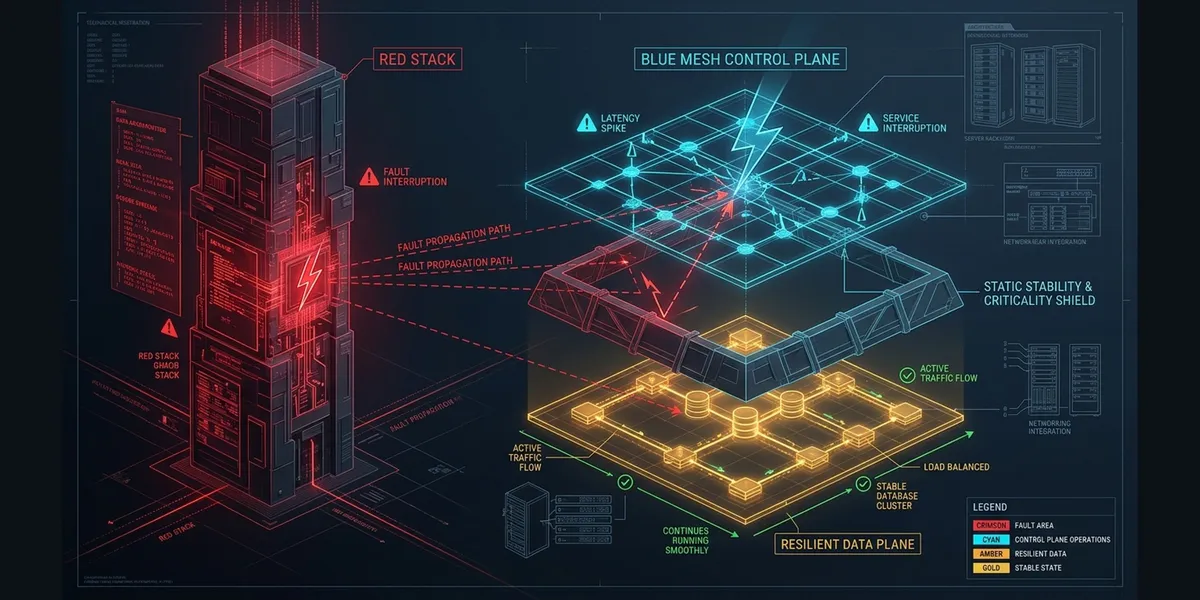
Original Thought & Source Lineage: This research note synthesizes a multi-part resilience series originally published on LinkedIn across 2025: The Architect’s Paradox: Static Correctness vs. Dynamic Criticality (March 29, 2025), Living Through Architectural Consequences (June 20, 2025,
998impressions), Death by a Thousand YAMLs (September 21, 2025), Cloud Control Planes Are the Real Single Points of Failure (November 19, 2025), and Oracle built the “Red Stack.” IBM is building the “Blue Mesh.” (December 8, 2025).
If you only watch application-layer hype—models, frontends, coding harnesses—you miss the biggest tectonic shift inside enterprise infrastructure over the past two years: vendor lock-in and catastrophic outage blast radius have both migrated upward into the automation and control plane.
Two phenomena I wrote about in late 2025—consolidation across horizontal infrastructure tooling (Red Stack vs. Blue Mesh) and correlated outages across hyperscaler DNS, edge gateways, and state control planes (Cloud Control Planes)—have only sharpened by November 2026. Worse still, organizations have wired AI inference routers, multi-agent orchestrators, and automated Terraform pipelines straight into those same shared control surfaces.
1. History Rhyming: From Oracle’s “Red Stack” to IBM’s “Blue Mesh”
I began my career as a PeopleSoft ecosystem developer right as Oracle assembled the “Red Stack”: PeopleSoft, Siebel, BEA WebLogic, Hyperion, Streams, GoldenGate, and eventually Sun (Java, MySQL, hardware). Oracle’s strategic thesis in the 2000s was vertical and unambiguous: “Run your business on our stack,” with the proprietary Oracle Database sitting as the economic gravity well at the center.
Fast-forward across two decades, and examine the horizontal chessboard assembled through 2025:
- OS & Containers: Red Hat / OpenShift
- Infrastructure as Code: HashiCorp / Terraform & Vault
- Event Streaming: Confluent / Kafka
- Distributed Data Platforms: DataStax / Cassandra
As I wrote on December 8, 2025, IBM ran a far subtler variation of the same consolidation play—not locking you into one application server, but owning the control planes across every cloud you touch:
Oracle’s 2000s bet: “Run your business on our stack.” IBM’s 2020s–2026 bet: “Run your business anywhere — as long as our tools orchestrate, automate, and stream it.”
Simultaneously, cloud-native architectures accumulated what I dubbed “Death by a Thousand YAMLs”: typical Kubernetes production deployments stacking 20+ ecosystem tools—ingress controllers, service meshes, secrets vaults, policy engines, observability collectors, and GitOps controllers. Even multi-cloud portability turned into an accounting illusion when every deployment pipeline depended on one unified automation vendor mesh and centralized identity broker.
2. Control Planes Are the Real Single Points of Failure
Every time major cloud and network incidents hit global headlines—across AWS DynamoDB/DNS control paths, Azure Front Door edge propagation, and Cloudflare global configuration planes—the post-incident lesson repeats word for word, as I distilled on November 19, 2025:
- Control planes are the real single points of failure. You can run three Kubernetes clusters across three availability zones, yet a single mis-propagated BGP/WAF/DNS rule or IAM token outage stops every region at once.
- You cannot test your way to zero failures. Complex distributed platforms generate emergent failure interactions that synthetic staging suites never exercise until correlated load strikes.
- Reliability is a trade-off, not an absolute. Treating 99.999% uptime as a purchase order from a hyperscaler rather than an explicit system boundary turns third-party blips into company-wide downtime.
- Architect for resilience, not perfection. Systems that rely on synchronous real-time control-plane lookups on every user request convert control-plane latency spikes into data-plane blackouts.
- Treat hyperscalers as powerful, not infallible.
By November 2026, teams introduced an additional control-plane fragility: routing deterministic business paths through hosted AI inference endpoints and cloud agent orchestration loops. When a transactional e-commerce fulfillment workflow blocks synchronously on an external LLM gateway or a hosted vector registry, you haven’t decentralized intelligence—you have welded another brittle external dependency directly onto your revenue path.
3. Empirical Reality in 2026: Host & IaC Mutations Are High-Blast-Radius Surfaces
The danger isn’t only hyperscaler control-plane bugs; it is autonomous agent drift inside local infrastructure and CI/CD control files.
In empirical triangulation across public multi-language pull-request corpora and security benchmarks:
CodeReviewer(11,013multilingual code reviews across141repositories) and host-boundary extraction surfaced hundreds of high-blast-radius changes concentrated inside containers, Kubernetes manifests, CI/CD pipelines (.github/workflows/), andDockerfileconfigurations—yet under automated review overload, infra mutations frequently slide alongside application changes without separated privilege gates.GitInject(19CI/CD evaluation scenarios, including11malicious prompt-injection attacks) showed how adversaries exploit unguarded CI workflows, agent instruction files (AGENTS.md,CLAUDE.md), and token configurations (pr_token_exfiltration_via_git_config) directly through pull-request control paths.
Adding autonomous YAML/Terraform generation into a 20-tool orchestration mesh without control-plane isolation widens the blast radius of a single misconfigured workflow change from one microservice to an entire cluster.
4. From Static Correctness to Barry O’Reilly’s Criticality
Why do smart engineering teams keep building brittle architectures despite thicker runbooks and longer checklists?
In March 2025, drawing on Barry O’Reilly’s Residuality Theory, I framed The Architect’s Paradox: designing strictly for static conformance to idealized specifications under expected conditions produces systems that shatter under unexpected turbulence.
Chasing Static Correctness asks: “Does this diagram verify all happy-path functional rules in an isolated staging test?” Designing for Dynamic Criticality asks: “When our cloud DNS stalls, our Terraform control plane locks, our Schema Registry is unreachable for 15 minutes, or our hosted LLM gateway returns 429s—does the core order/settlement engine still sustain its essential purpose?“
---
config:
  layout: elk
---
flowchart TD
    %% title: Control-Coupled Design vs. Criticality-Driven Isolation
    subgraph Idealized["1. Fragile Control-Coupled Design (Optimizes Static Correctness)"]
        U1["User / Order Request"]:::intakeNode
        CP1["Sync Dependency on Control Plane\n(IAM Policy Push + Edge Gateway + LLM Gateway)"]:::warnNode
        DP1["Business Data Plane"]:::codeNode
        Outage["Total System Freeze\n(Blast Radius = 100%)"]:::dangerNode
    end

    subgraph Resilient["2. Criticality-Driven Isolation (Fails Small)"]
        U2["User / Order Request"]:::intakeNode
        Edge["Data Plane with Static Stability\n(Cached Auth Keys + Stale-While-Revalidate Routes)"]:::safeNode
        Control["Asynchronous Control Mesh\n(Blue Mesh / GitOps / LLM Enrichment)"]:::gateNode
        Fallback["Deterministic Core Execution\n(Transactional Outbox + Rule Fallback)"]:::safeNode
    end

    U1 e1@==> CP1
    CP1 e2@-->|"Healthy"| DP1
    CP1 e3@==>|"Global Control Plane Stumble"| Outage

    U2 e4@==> Edge
    Control [email protected]>|"Eventual Config Sync (Out-of-Band)"| Edge
    Edge e6@==>|"Circuit Broken / Degraded"| Fallback

    e1@{ animate: true }
    e3@{ animate: true }
    e4@{ animate: true }
    e6@{ animate: true }

    classDef intakeNode fill:#1E293B,stroke:#38BDF8,stroke-width:2px,color:#F8FAFC
    classDef warnNode fill:#FFFBEB,stroke:#D97706,stroke-width:2px,color:#111111
    classDef dangerNode fill:#FEF2F2,stroke:#DC2626,stroke-width:2.5px,color:#7F1D1D
    classDef codeNode fill:#F5F3FF,stroke:#7C3AED,stroke-width:2px,color:#4C1D95
    classDef gateNode fill:#EFF6FF,stroke:#2563EB,stroke-width:2px,color:#1E3A8A
    classDef safeNode fill:#ECFDF5,stroke:#059669,stroke-width:2.5px,color:#064E3B
---
config:
layout: tidy-tree
---
mindmap
root(("Criticality & Control-Plane Resilience"))
("1. Static Stability on Data Plane")
("Signed Local JWKS Auth Caches")
("Stale-While-Revalidate Routing")
("Zero Sync Control-Plane Lookups")
("2. Quarantine AI Gateways")
("Async Enrichment Outside ACID")
("Polly / Envoy Circuit Breakers")
("Deterministic Rule Fallbacks")
("3. Partition IaC & Workflow PRs")
("Separate CODEOWNERS for .github/workflows")
("OPA / Conftest Policy-as-Code")
("GitInject Prompt-Injection Guards")
("4. Blue Mesh Portability Joints")
("OpenTelemetry Native Signals")
("Standard Apache Kafka Wire Protocol")
("Thin OCI & IaC Boundaries")5. Four Architectural Rules for Failing Small in Late 2026
You don’t build criticality by writing an inspiring reliability charter. You build it by severing synchronous dependencies between Control Planes and Data Planes, and by enforcing what I stressed in June 2025:
“An architect who hasn’t lived with the consequences of their own designs shouldn’t be trusted to make the next one.”
Put four concrete circuit breakers into practice across your estate:
- Demand Static Stability on the Data Plane: Design payment processing, warehouse dispatch, authentication verification, and edge routing so that existing traffic continues smoothly using last-known-good local state (signed JWKS caches, cached feature/routing snapshots, local fallback rule tables) even if central configuration or identity control planes go dark for hours.
- Quarantine AI Gateways Outside Synchronous ACID Paths: Never allow a synchronous checkout, dispatch, or inventory transaction to wait unguarded on an external frontier model endpoint. Enrich asynchronously; fall back deterministically via circuit breakers (
Polly/ Envoy timeouts) when inference degrades. - Partition IaC & Workflow PRs From Application PRs: Apply stricter cryptographic provenance, separate
CODEOWNERS, and policy-as-code gates (OPA/Conftest) whenever a human or agent mutates.github/workflows/,Dockerfile, Helm charts, or Terraform modules—never let automation YAML ride inside noisy feature PRs. - Preserve Portability Joints Across Any “Blue Mesh”: Bet on standard wire protocols (native OpenTelemetry signals over proprietary collectors, open Apache Kafka client contracts over vendor-specific control APIs, standard OCI containers, thin IaC modules) so commercial bundling across your orchestration layer never turns into unbreakable dependency lock-in.
Reliability isn’t an SLA certificate on a vendor’s status page. It is the deliberate architectural discipline of designing systems that fail small, degrade gracefully, and keep their core commitment alive when the control plane stumbles.