Be the Editor, Not the Author: Shrinking the Decision Space and Pricing the Three-Year TCO of "Free" AI Code
Why industry absolutes fail without Contextual Bias, how frontier models expose the 0→1 vs. 1→N boundary in 2026, and why 'SaaS is Dead' hype ignores Day-2 coupling and verification costs.
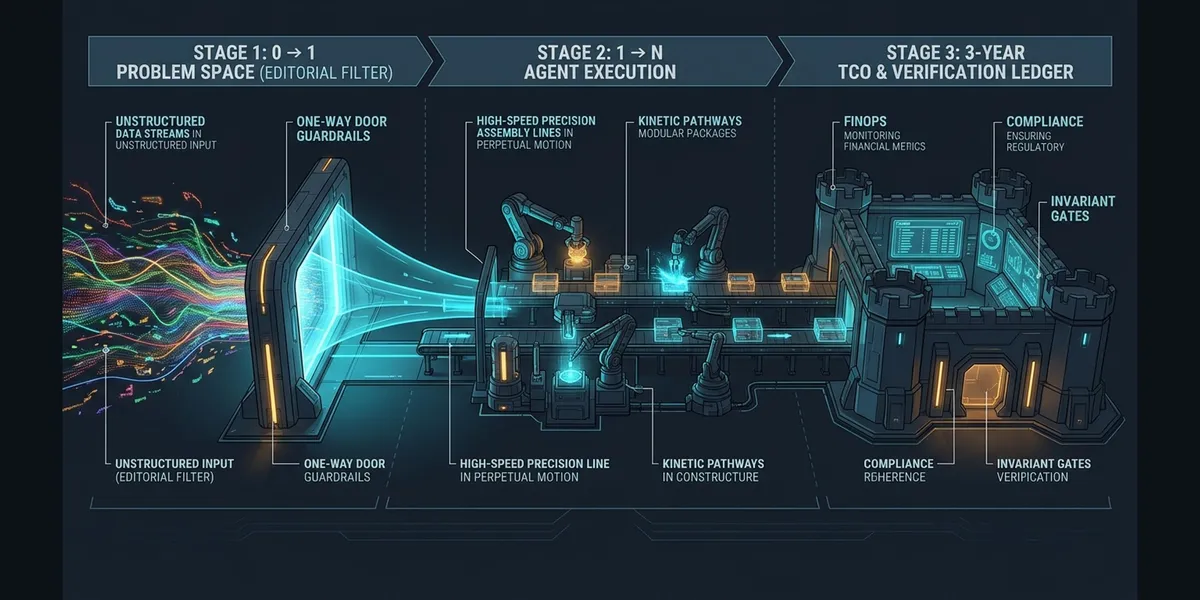
Original Thought & Source Lineage: This perspective weaves together three Medium essays—SaaS Evaluation in GenAI Era (August 25, 2025), The Signal in the Noise: Architecture in the Age of Absolutes (January 4, 2026), and The Multiplier Architect: Being Opinionated Without Being a Tyrant (January 4, 2026)—with three 2026 LinkedIn reflections: MS Build 2026’s “Unmetered Intelligence” & token economics (June 2, 2026), The 0→1 vs. 1→N Boundary (July 28, 2026), and The Architect and the Devil’s Advocate (October 9, 2026).
Enterprise technology moves in swings of confident absolutes. One quarter, microservices are mandatory everywhere; the next quarter, an infrastructure post-mortem (such as AWS Prime Video consolidating a distributed Step Functions and Lambda video monitoring pipeline back into a single service) convinces teams that every microservice was a mistake.
In 2026, that pendulum swung hardest on Build vs. Buy: “Why renew a six-figure SaaS contract when our engineers can vibe-build an internal replacement over a long weekend?”
Wait ten months—until November 2026—and look at the engineering ledgers of teams that actually took that leap. Very few failed to build the initial demo. Almost all underestimated the three-year total cost of ownership, the cognitive bottleneck of uncurated choices, and the quiet distinction between 0→1 problem framing and 1→N code generation.
1. Contextual Bias & Shrinking the Decision Space
In The Signal in the Noise, I argued that generic architecture trend pieces are pure noise until passed through Contextual Bias—your organization’s specific failure tolerance, compliance posture, team topology, and legacy gravity.
Yet there is a trap awaiting architects who take nuance seriously: becoming an “Option Catalog.” Under generative AI tooling, anyone can spit out twelve plausible architecture alternatives in fifteen seconds. Adding a thirteenth caveat does not help a delivery team ship cleanly.
As I reflected on October 9, 2026, senior architectural leadership requires shifting from permanent Devil’s Advocate to Decision-Space Reducer:
- Before raising one more edge-case objection, ask: “Did I just introduce another concern, or did I improve the resolution of the decision?”
- Distinguish an
#ImplementationDecision(reversible local plumbing) from a#PlatformDecision(structural gravity affecting five teams for five years). - Learn to say “I don’t know that yet—but is knowing it material enough to alter this decision right now?”
That pairs directly with the core split in The Multiplier Architect (adapting Liz Wiseman’s Multipliers):
| Decision Class | Door Type | Ownership Pattern | Examples in 2026 AI Teams |
|---|---|---|---|
| Hard Opinions | One-Way Doors (high reversal cost) | Owned & enforced strictly by the Architect + CI gates | Data tenancy isolation, schema/wire compatibility, auth boundaries, transactional outbox guarantees, clean-core COTS stop rules |
| Soft Opinions | Two-Way Doors (cheaply reversible) | Delegated cleanly to domain teams & coding agents | Internal helper abstractions, serializer preference inside isolated slices, test naming syntax, local UI state patterns |
Being opinionated everywhere turns an architect into a Human Gatekeeper Bottleneck—a dynamic proven empirically across 521 active GitHub repositories in our research telemetry, where a single top reviewer absorbs an average 66.43% of human review workload and 23.42% of repositories operate at Bus Factor = 1. Hard opinions should shrink the dangerous decision space before implementation begins, leaving teams and coding agents free inside safe boundaries.
2. The 0→1 vs. 1→N Boundary in November 2026
By mid-2026, watching teams push frontier coding harnesses across Claude Opus / Sonnet, OpenAI o-series / GPT-5, and Gemini agentic workflows exposed an unmistakable fault line that I wrote about on July 28, 2026:
---
config:
  layout: elk
---
flowchart TB
    %% title: 0→1 Problem Framing vs. 1→N Agent Execution
    subgraph Zone01["1. 0 -> 1 Problem Space (Human Editorial Anchor)"]
        A["Ill-Defined Business Need"]:::intakeNode
        B["Discover Competing Constraints\n(Org Politics + Legacy Gravity + FinOps)"]:::gateNode
        C["Editorial Trade-Off\nChoose Least-Wrong Architecture"]:::accentNode
    end

    subgraph Zone1N["2. 1 -> N Execution Space (Agent Leverage)"]
        D["Expand Locked Contracts\n& Explicit Hard Opinions"]:::codeNode
        E["High-Speed Implementation\nCodegen + Refactors + Tests"]:::safeNode
    end

    subgraph ZoneTCO["3. 3-Year TCO & Verification Ledger"]
        F["3-Year TCO Audit\n(Compliance + Drift + Upgrade Tax)"]:::dangerNode
    end

    A e1@==> B
    B e2@==> C
    C e3@==>|"Locked One-Way Doors"| D
    D e4@==> E
    C e5@-.->|"Editorial Filter"| F
    E e6@-->|"Day-2 Feedback"| F

    e1@{ animate: true }
    e2@{ animate: true }
    e3@{ animate: true }
    e4@{ animate: true }

    classDef intakeNode fill:#1E293B,stroke:#38BDF8,stroke-width:2px,color:#F8FAFC
    classDef gateNode fill:#FFFBEB,stroke:#D97706,stroke-width:2px,color:#111111
    classDef accentNode fill:#EFF6FF,stroke:#2563EB,stroke-width:2.5px,color:#1E3A8A
    classDef codeNode fill:#F5F3FF,stroke:#7C3AED,stroke-width:2px,color:#4C1D95
    classDef safeNode fill:#ECFDF5,stroke:#059669,stroke-width:2px,color:#064E3B
classDef dangerNode fill:#FEF2F2,stroke:#DC2626,stroke-width:2px,color:#7F1D1D- Where Agents Already Outrun Us (
1→N): Given crisp constraints, schema contracts, and localized scope, frontier coding harnesses expand specifications into idiomatic implementations, localized refactors, and test coverage faster than senior engineers can type. - Where Agents Still Stall (
0→1): When the requirement itself is murky, stakeholder incentives conflict across ERP/legacy estates, compliance liabilities (SOC 2,ISO 27001,HIPAA,PCI DSS) sit under ambiguity, or a platform shift forces irreversible cost commitments, models optimize for local plausibility over enterprise consequence.
Architecture was never about generating the theoretically cleanest diagram. It has always been choosing the least-wrong trade-off among competing organizational constraints.
3. Pricing the 3-Year TCO of “Free” AI Code ("SaaS is Dead")
That 0→1 vs. 1→N split explains why the 2025–2026 “SaaS is Dead” narrative hits a wall when CFOs and VP Engineering leaders calculate 3-Year Total Cost of Ownership.
In Case Study B of The Signal in the Noise, and earlier in SaaS Evaluation in GenAI Era, I warned against pricing custom AI builds solely at Day-1 code generation cost. By November 2026, four real empirical forces confirm why “zero build cost” does not equal “zero ownership cost”:
- Multi-Turn Conflict & Merge Churn Aren’t Free: Across
142,652multi-agent PRs in the AgenticFlict corpus, automated parallel development triggered29,609conflict events (20.76%macro conflict rate) averaging149.8conflict lines per collided change. Every unquarantined feature you pull in-house adds compounding surface area where autonomous runs collide. - Unreviewed Velocity Creates Hidden Stabilization Taxes: Across
26,779inline code-patch reviews inAIDev, merged AI-assisted PRs still carried1,003broad exception handlers,354suppressed linter/type checks, and709explicit security or bug warnings. Cheaply synthesized CRUD software accumulates latent operational risk unless you pay continuously for verification infrastructure. - Token Economics Still Meter Complexity (With Decision Models Still Unproven at TCO Scale): Even as MS Build 2026’s opening keynote touted “Unmetered Intelligence”, metering and token economics shifted front-and-center across enterprise FinOps reviews. Replacing deterministic SaaS workflows with generative agent-operated in-house glue swaps predictable seat licenses for variable inference bills, observability pipelines, and human escalation queues—and while emerging System One decision models like Jev (alongside peer decision-only classifiers such as
Microsoft-Decision-1andd1) bypass open-ended text generation to emit typed, bounded decisions at a fraction of generative LLM inference cost, we are yet to observe their net real-world effect on three-year enterprise TCO and workflow metering. - Commodity Plumbing Compounds Vendor Leverage: When you rebuild commodity billing, audit trails, SOC 2 logging, payroll rules, or multi-carrier tax compliance in-house using an agent, you haven’t eliminated vendor lock-in—you have just appointed yourself the permanent maintenance vendor for zero competitive differentiation.
---
config:
  layout: tidy-tree
---
mindmap
  root(("Editorial Architecture Rubric"))
    ("1. Decision-Space Reduction")
      ("Hard Opinions: One-Way Doors")
      ("Soft Opinions: Two-Way Doors")
      ("Prevent Bus-Factor-1 Gatekeeping")
    ("2. 0->1 vs 1->N Split")
      ("0->1: Human Context & Trade-offs")
      ("1->N: Agent Execution Under Constraints")
    ("3. 3-Year TCO Ledger")
      ("20.76% Multi-Agent Merge Conflict Tax")
      ("Continuous Verification & Compliance")
      ("Variable Token & Inference FinOps")
    ("4. Innovation Tokens")
      ("2-3 Tokens Per Year")
      ("Spend Only on Differentiating Core")
      ("Buy Commodity Back-Office SaaS")
4. The Editorial Rubric: Acting as Editor, Not Author
To evaluate any Build vs. Buy vs. Agent-Compose decision cleanly in November 2026, apply the three editorial filters I proposed in January 2026 alongside your GenAI SaaS Scoring Matrix:
- The Innovation Tokens Test (Dan McKinley): Every enterprise team holds roughly 2 to 3 innovation tokens per year—areas where you can afford bespoke edge complexity. Spend them strictly on your differentiating core domain (underwriting logic, proprietary pricing, fulfillment edge), never on rebuilding commodity back-office SaaS just because an agent offered to scaffold it.
- The Three-Year Maintenance & Verification Multiplier: Price any bespoke build by adding continuous verification cost: CI invariant suites, security compliance audits (
GDPR/HIPAA/PCI), third-party dependency upgrades, and on-call triage across 36 months—not Week-1 build hours. - Fitness Functions & Mandatory POCs: Before committing a One-Way Door (either buying an opaque “AI-washed” vendor tool or greenlighting an in-house build), define objective Fitness Functions (latency ceiling, data retention/training-opt-out clause, multi-tenant isolation, upgrade exit path) and validate them via a time-boxed Proof of Concept, never vendor slide decks.
In an era where generating code takes seconds, the highest-leverage technical leaders do not brag about how much software they authored. They act as ruthless Editors: discarding unnecessary components, delegating reversible implementation to teams and agents, rationing bespoke code strictly to differentiating domain edges, and shrinking the decision space until execution becomes unmistakable.