Contract-First .NET Beyond Codegen: OpenAPI, AsyncAPI Event Meshes, and Temporal Invariants
Why generating .NET clients from OpenAPI and Terraform from AsyncAPI solved static drift in 2025—yet autonomous agents and multi-agent protocols in 2026 require transactional outbox and temporal state-machine contracts.
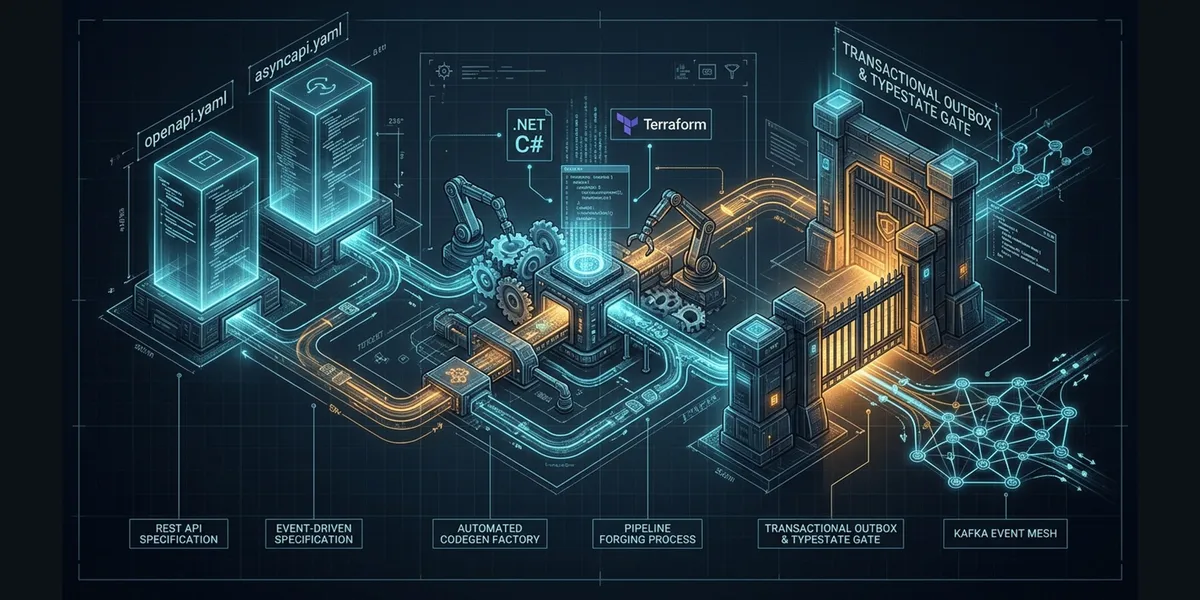
Original Thought & Source Lineage: This practitioner note synthesizes three foundational 2025 publications: Implementing API Design First in .NET for Efficient Development, Testing, and CI/CD (DZone, May 23, 2025 —
6,183views), API Design First: AsyncAPI in .Net (DZone, September 8, 2025 —2,773views; companion code inkumarshaz/kafka-dotnet), and The Evolving Landscape of AI Communication: From IPC to MCP and A2A (Medium, April 27, 2025; DZone cross-post August 22, 2025,2,659views).
A stubborn pattern still dominates .NET shops even after a decade of “API Design-First” consensus: teams write the ASP.NET Core controller and C# record classes first, wire up Swashbuckle or OpenAPI reflection, and call the emitted JSON document a contract.
In May and September 2025, I documented an alternative end-to-end discipline across both synchronous HTTP APIs and asynchronous Kafka meshes: treating hand-authored, versioned specifications (openapi.yaml and asyncapi.yaml) as the single build-time authority from which both application code and infrastructure topology are derived.
By November 2026, coding agents and multi-agent integration protocols (MCP for agent-to-tool links and A2A for agent-to-agent delegation) proved that design-first specs were half the battle—and exposed the next boundary we ignored: static schemas validate shapes, not time.
1. Synchronous Contracts in .NET: Breaking the Code-First Reflex
The appeal of code-first Swashbuckle is speed on Day 1. The cost shows up on Day 30 when a frontend team, a partner gateway, and a .NET backend drift silently over nullable fields or changed HTTP status codes.
In my May 2025 DZone guide, the practical cure required three concrete mechanisms rather than slideware:
- Dual-Spec Drift Visibility: Serve both the authoritative static
openapi.yamldesign contract and the live reflected runtime specification side-by-side inside Swagger UI (SwashbuckleUI configured with two endpoints) during local and QA builds. Any discrepancy between intended contract and compiled route jumps off the screen. - Deliberate Codegen Selection: Pick your generator according to organizational coupling:
| Tooling Option | Strengths in .NET Pipelines | Best Fit | Watch-Out |
|---|---|---|---|
Microsoft Kiota | Clean idiomatic C# typed fluent SDKs, lightweight runtime footprint, strong OpenAPI 3.0/3.1 alignment | Enterprise internal SDK consumers & API gateways | Primarily client-focused; pair with typed server endpoints |
NSwag | Native .NET ecosystem toolchain, solid C# client + controller generation, NJsonSchema ecosystem | All-.NET teams wanting zero Node/Java build dependencies | Generated inheritance hierarchies need discipline to avoid mixing domain and transport models |
openapi-generator-cli | Polyglot (C# + TypeScript + Java + Go) from one YAML; flexible templates | Mixed frontend/backend orgs + Azure API Management (APIM) | Heavy Java CLI toolchain; needs CI caching & template pinning |
| Swashbuckle Reflection | Instant feedback from code annotations | Prototyping & documenting actual runtime surface | Never treat reflected output as the authoritative contract |
- Pipeline-Backed Verification: Lock
openapi.yamlin source control and enforce validation inside Azure DevOps / GitHub Actions before deployment:- Lint & break-check the OpenAPI YAML (
Spectral/oasdiff). - Run contract assertions (
NJsonSchema.Validation,FluentAssertions,WireMock.Net,Microsoft.AspNetCore.Mvc.Testing) verifying every error payload (ProblemDetailsRFC 9457), status code, and schema rule. - Publish typed NuGet consumer packages directly from CI and sync policies cleanly into Azure API Management (APIM) rather than editing portal XML manually.
- Lint & break-check the OpenAPI YAML (
2. Asynchronous Event Meshes: Co-Generating C# and Terraform (AsyncAPI)
Asynchronous Kafka architectures fail for a subtler reason than REST APIs: topology drift. A developer renames a topic, tweaks partition counts for ordering, or drops a compatibility header—while Terraform infra repos and consumer services go out of sync.
In my September 2025 AsyncAPI walkthrough and kumarshaz/kafka-dotnet, I tackled missing official C# + Terraform AsyncAPI tooling by authoring a focused Handlebars generator parsing AsyncAPI v2.5.0 Kafka bindings. One machine-readable asyncapi.yaml emitted two synchronized outputs:
- Application Layer: Strongly typed C# domain event POCOs (
JsonSchemaconstraints mapped cleanly), Confluent Kafka producers/consumers wired with correlation ID headers, and Dead Letter Queue (DLQ) routing scaffolding. - Infrastructure Layer: Matching Terraform (
kafka_topic, partition count, replication factor, retention MS, and least-privilege ACLs) committed right next to the application build.
---
config:
  layout: elk
---
flowchart TD
    %% title: OpenAPI & AsyncAPI Dual Codegen Pipeline
    subgraph SpecLayer["1. Authoritative Specification Source"]
        Spec["Authoritative Contracts\n(openapi.yaml + asyncapi.yaml)"]:::specNode
        Lint["CI Schema Linter & Breaking-Change Diff\n(oasdiff + Schema Registry Compatibility)"]:::gateNode
    end

    subgraph CodegenLayer["2. Deterministic Dual Codegen"]
        GenCode["Co-Generated .NET Artifacts\n(Kiota Client + Typed Interfaces + C# Event POCOs)"]:::codeNode
        GenInfra["Co-Generated Infra Artifacts\n(APIM Policies + Terraform Topics & ACLs)"]:::infraNode
    end

    subgraph RuntimeBoundary["3. Runtime Invariant & Event Mesh"]
        Outbox["Runtime Invariant Boundary\n(Transactional Outbox + Typestate Guard)"]:::gateNode
        Broker["Kafka Event Mesh & API Gateway"]:::safeNode
        Quarantine["Blocked at Boundary\n(DLQ + OTel Trace + Alert)"]:::dangerNode
    end

    Spec e1@==> Lint
    Lint e2@==> GenCode
    Lint e3@==> GenInfra
    GenCode e4@==> Outbox
    GenInfra e5@==> Broker
    Outbox e6@==>|"Atomic DB Commit -> Relay"| Broker
    Outbox e7@-.->|"Protocol / Typestate Violation"| Quarantine

    e1@{ animate: true }
    e2@{ animate: true }
    e3@{ animate: true }
    e4@{ animate: true }
    e6@{ animate: true }

    classDef specNode fill:#1E293B,stroke:#38BDF8,stroke-width:2px,color:#F8FAFC
    classDef gateNode fill:#FFFBEB,stroke:#D97706,stroke-width:2px,color:#111111
    classDef codeNode fill:#EFF6FF,stroke:#2563EB,stroke-width:2px,color:#1E3A8A
    classDef infraNode fill:#F5F3FF,stroke:#7C3AED,stroke-width:2px,color:#4C1D95
    classDef safeNode fill:#ECFDF5,stroke:#059669,stroke-width:2.5px,color:#064E3B
    classDef dangerNode fill:#FEF2F2,stroke:#DC2626,stroke-width:2px,color:#7F1D1D
If an architect enforces compatibility rules in Confluent Schema Registry (BACKWARD_TRANSITIVE or FULL_TRANSITIVE) alongside generated Terraform ACLs, no service accidentally poisons a shared Kafka topic with ad-hoc JSON strings.
3. The November 2026 Reality: Why SchemaValid Does Not Mean ProtocolValid
Fast-forward to late 2026. Every major coding agent writes fluent OpenAPI YAML, AsyncAPI specs, and System.Text.Json serialization fixtures without breaking a sweat. Yet distributed .NET systems integrating coding agents and partner workflows keep failing in production. Why?
Two major 2026 trends collided right on top of our API boundaries:
Trend 1: Connectivity Commoditized; Orchestration & State Became the Bottleneck
In my April 2025 communication evolution analysis, I traced enterprise messaging from OS-level IPC and sockets through ESBs, iPaaS, Kafka, and into MCP (agent-to-tool/data) and A2A (agent-to-agent negotiation). By November 2026, MCP tool definitions and A2A Agent Cards have essentially commoditized transport discovery—just as HTTP and JSON commoditized RPC syntax years ago.
Because transport schemas are now cheap to generate, teams expose hundreds of internal endpoints and Kafka events directly as agent tools. The moment an autonomous workflow orchestrates a multi-step business capability across those tools, structural schema validation catches serialization bugs (string vs. int), while temporal state-machine violations slip cleanly past green OpenAPI checks:
- Calling
CapturePaymenton a valid payment DTO beforeAuthorizeHoldcompletes. - Performing dual-writes (saving
Orderin SQL Server and firingOrderCreatedto Kafka inside the same method, leaking phantom events when SQL rolls back). - Issuing parallel A2A/MCP retries without cryptographic
IdempotencyKey+ monotonic sequence enforcement, triggering duplicate settlements.
In empirical software engineering analysis, we call this the Syntactic–Typestate Gap: an agent-synthesized change passes 100% of static schema validators and mocked local unit tests (local pass = 1.0), yet breaks the cross-service state protocol over time.
---
config:
  layout: tidy-tree
---
mindmap
  root(("Contract-First .NET 2026"))
    ("1. Synchronous OpenAPI")
      ("Dual-Spec Drift UI")
      ("Kiota / NSwag Codegen")
      ("oasdiff + WireMock CI")
    ("2. Asynchronous AsyncAPI")
      ("C# Event POCOs")
      ("Co-Generated Terraform Topics & ACLs")
      ("Schema Registry Compatibility")
    ("3. Temporal Invariants")
      ("Sealed Typestate Records")
      ("Monotonic Sequence Guards")
      ("Idempotency-Key Enforcement")
    ("4. Transactional Outbox")
      ("Single ACID Commit")
      ("Causation & Correlation Headers")
      ("Zero Phantom Dual-Writes")
4. Upgrading Contract-First .NET With Temporal & Outbox Invariants
Closing that gap in 2026 doesn’t require throwing away OpenAPI or AsyncAPI. It requires promoting temporal state transitions and atomic delivery guarantees into the contract itself.
Pattern A: Encode Protocol Preconditions via Sealed Typestate Records
Stop exposing flat CRUD RPCs (UpdateOrderStatus(id, newStatus)) where any caller or LLM tool call can jump from Cancelled back to Shipped. Model legal transitions directly in .NET interfaces and OpenAPI discriminator schemas:
namespace Fulfillment.Contracts;

public enum OrderState { Draft, Authorized, Reserved, Shipped, Cancelled }

// Only an AuthorizedOrder token can enter Inventory Reservation;
// agents and handlers cannot call ReserveAsync with a DraftOrder.
public sealed record DraftOrder(Guid OrderId, decimal TotalAmount);
public sealed record AuthorizedOrder(Guid OrderId, string AuthorizationToken, DateTimeOffset AuthorizedAt);
public sealed record ReservedOrder(Guid OrderId, string ReservationId, int SequenceVersion);

public interface IFulfillmentProtocol
{
    Task<Result<AuthorizedOrder>> AuthorizeAsync(
        DraftOrder draft,
        string idempotencyKey,
        CancellationToken ct);

    Task<Result<ReservedOrder>> ReserveInventoryAsync(
        AuthorizedOrder authorized,
        string idempotencyKey,
        CancellationToken ct);
}
When exposed via HTTP or MCP tool adapters, the gateway validates both the typed payload and the monotonic (OrderId, ExpectedState, SequenceVersion) guard against optimistic concurrency (409 Conflict / 412 Precondition Failed) before touching state.
Pattern B: Require the Transactional Outbox in Every AsyncAPI Contract
Treat “publish inside handler after DB save” as a banned anti-pattern in architecture unit tests. Any AsyncAPI producer must write domain mutations and outbox events inside the same ACID database transaction, accompanied by mandatory metadata headers in asyncapi.yaml:
components:
  messageTraits:
    EnterpriseEventEnvelope:
      headers:
        type: object
        required: [x-correlation-id, x-idempotency-key, x-causation-id, x-aggregate-version]
        properties:
          x-correlation-id:
            type: string
            format: uuid
          x-idempotency-key:
            type: string
          x-causation-id:
            type: string
          x-aggregate-version:
            type: integer
            minimum: 1
This single message trait forces every .NET producer (human or AI-generated) to bind distributed trace causation and idempotent deduplication directly into the Kafka contract—meaning consumers and AI tool relays can safely drop duplicate agent retries at O(1) database cost.
5. The Contract-First Maturity Checklist for Late 2026
If you run .NET microservices or Kafka meshes today, audit your delivery pipeline against five crisp checks:
- Authoritative Source Check: Does your
openapi.yamlandasyncapi.yamlgenerate your C# DTOs and Kafka bindings—or are static specs rotting downstream of Swashbuckle controllers? - Infra Symmetry Check: Are Kafka topic partitions, retention windows, Schema Registry rules, and DLQs generated from the same AsyncAPI truth (
Terraform/Bicep), or configured ad-hoc in portals? - Outbox Guarantee: Does every published event commit inside the domain database transaction before relay, eliminating dual-write split-brain?
- Protocol Order Guard: Do external REST/MCP/A2A commands enforce legal state transitions (
ExpectedState+Idempotency-Key) rather than generic status-patch endpoints? - Runtime Drift Check: Does CI run
oasdiff+ contract suites (WireMock.Net/ Testcontainers) on every PR so neither humans nor agents silently ship breaking wire behavior?
Schema-first stopped being an optional documentation exercise when human microservices scaled past ten teams. Once autonomous coding agents and MCP tool callers entered the loop in 2026, stateful contract-first architecture became the difference between composable speed and distributed chaos.