The Anatomy of a Clean Core: From 2015 PeopleSoft Sidecars to 2026 AI-Accelerated COTS Stop Rules
An eleven-year architectural throughline: how clean-core ERP boundary isolation from 2015 scales into four quantitative circuit breakers that stop AI coding agents from turning SaaS and low-code platforms into unmaintainable spaghetti.
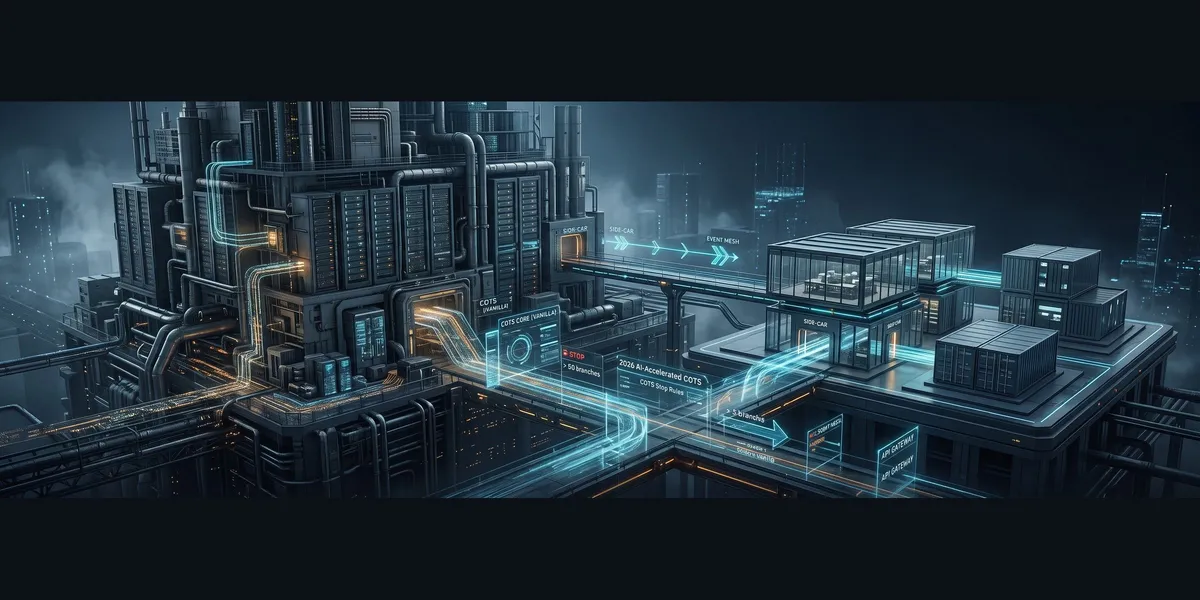
Original Thought & Source Lineage: This article traces an eleven-year architectural thread across four of my LinkedIn publications: two August 2015 deep-dives into PeopleSoft clean-core decoupling—Executing Remote Application Business/Data Logic on PIH Event (LinkedIn Pulse, August 26, 2015) and PeopleSoft to Third Party and vice-e-verse Single Sign On (LinkedIn Pulse, August 30, 2015)—followed by COTS vs. Bespoke App Adoption (February 22, 2022) and codified into hard circuit breakers in The 4 LCNC & COTS Architectural Stop Rules (January 14, 2026).
Enterprise architects love debating bleeding-edge patterns, yet some of the most expensive failures I have seen over two decades happen in supposedly “bought, not built” software: CRM, ERP, Order Management, and Low-Code/No-Code (LCNC) suites.
Whenever an organization buys a Commercial Off-The-Shelf (COTS) platform, it pays a steep licensing premium for two promises: speed to market and vendor-managed upgrades. Then, six months after go-live, a business unit insists on a custom pricing exception or multi-system approval flow. Nobody wants to spin up a standalone service—so they squeeze the logic inside the vendor’s proprietary escape hatch.
Eleven years ago, I documented that exact boundary battle inside Oracle PeopleSoft. By November 2026, generative coding agents haven’t cured this disease—they have removed the friction that used to slow it down.
1. The 2015 Clean-Core Precedent: Refusing to Pollute the Portal
Back in August 2015, while architecting Oracle PeopleSoft Interaction Hub (PIH) portals, teams routinely ran into a tempting trap: a portal event needed custom Financials data (such as Chart of Accounts attributes) stored across another PeopleSoft pillar (HCM vs. FSCM).
The naive COTS customization path was clear: copy those custom fields into PIH’s Configurable Profile Management tables, write batch sync jobs, and maintain custom PeopleCode inside the portal core. Six upgrades later, every patch cycle became multi-month regression surgery.
In my August 26, 2015 Pulse article, I documented the clean-core alternative:
- Zero Data Duplication Inside the Core: Refuse to replicate domain attributes from FSCM/HCM into PIH tables simply to render a portal trigger.
- Remote Facade Delegation: Execute remote content-provider
iScriptlogic directly on the owning application server (htmlProcessor signon PeopleCode routing hooks), trading a tiny initial redirect latency for complete upgrade isolation. - Explicit Identity Boundaries at the Perimeter: As detailed four days later in my August 30, 2015 SSO teardown, keep authentication translation out of business code—bridging mutual trust across
PS_TOKENcookies,PRTL_SS_CIComponent Interfaces,SetAuthenticationResult, and reverse-proxy header injection via Oracle Access Manager (OAM) while cleanly isolating casual gateway sessions from core 3-tier users.
The technology names change (PeopleCode and OAM then; Salesforce Apex, SAP BTP, NetSuite SuiteScript, ServiceNow Flow Designer, Entra ID, and MACH/PBC sidecars today). The structural law never moves: never turn your system of record into an application server for cross-domain glue.
2. The November 2026 Paradox: Why Coding Agents Made COTS Shoehorning Worse
As I noted in my February 2022 reflection on COTS vs. Bespoke, low-code platforms genuinely compress simple workflows when configured close to standard behavior. Historically, however, proprietary scripting languages acted as a natural speed bump: writing 400 lines of gnarly SuiteScript or Apex hurt enough that developers pushed back and asked for a proper microservice.
By November 2026, that speed bump vanished. Frontier coding agents generate vendor-specific scripts, drag-and-drop JSON workflow exported definitions, and brittle API webhooks in under a minute. The short-term friction fell to zero while the platform coupling penalty stayed identical:
- Governor limits, synchronous trigger timeouts, and hidden batch recursion inside SaaS multi-tenant sandboxes don’t disappear just because an AI wrote the
Apextrigger cleanly. - Automated vendor seasonal upgrades still collide blindly with custom metadata overrides.
- Worse yet, AI-authored glue written inside proprietary COTS sandboxes rarely receives the CI test harnesses, contract assertions, or OpenTelemetry tracing that first-class pro-code repositories enjoy.
Fast generation inside a constrained COTS core simply accelerates the creation of an unupgradeable distributed monolith.
3. The Four Hard Architectural Stop Rules
To settle endless “just put it in a Salesforce Flow / SAP exit / Power Automate script” debates cleanly, every enterprise platform needs mechanical exit gates—not subjective arguments. In my January 14, 2026 LinkedIn framework, I codified four objective Architectural Stop Rules:
---
config:
  layout: elk
---
flowchart TD
    %% title: The Four COTS Architectural Stop Rules
    subgraph Intake["1. Requirement Intake"]
        Req["New Enterprise Requirement"]:::intakeNode
    end

    subgraph CircuitBreakers["2. Quantitative COTS Stop-Rule Gates"]
        R4{"Rule 4: Vanilla Fit >= 90%?\n(Standard COTS Config)"}:::gateNode
        R1{"Rule 1: Proprietary Script > 50 LOC?\n(Apex / ABAP / SuiteScript)"}:::gateNode
        R2{"Rule 2: LCNC Workflow > 5\nDecision Diamonds or Loops?"}:::gateNode
        R3{"Rule 3: Connects > 3 Distinct\nSystems of Record?"}:::gateNode
    end

    subgraph ExecutionTargets["3. Enforced Execution Boundary"]
        Vanilla["STOP Customization\nAdapt Business Process to COTS Standard"]:::safeNode
        Sidecar["TRIGGER SIDECAR\nExtract to Out-of-Process Pro-Code Service"]:::dangerNode
        ESB["TRIGGER API / EVENT MESH\nBuild Contract-First Integration Gateway"]:::accentNode
        CoreSafe["Allow Lightweight COTS Extension\nKeep Upgrade-Safe & Logged"]:::safeNode
    end

    Req e0@==> R4
    R4 e1@==>|"Yes (>=90% Fit)"| Vanilla
    R4 e2@-->|"No (<90% Fit)"| R1
    R1 e3@==>|"Yes (>50 LOC)"| Sidecar
    R1 e4@-->|"No (<=50 LOC)"| R2
    R2 e5@==>|"Yes (>5 Branches)"| Sidecar
    R2 e6@-->|"No (<=5 Branches)"| R3
    R3 e7@==>|"Yes (>3 SORs)"| ESB
    R3 e8@-->|"No (<=3 SORs)"| CoreSafe

    e0@{ animate: true }
    e1@{ animate: true }
    e3@{ animate: true }
    e5@{ animate: true }
    e7@{ animate: true }

    classDef intakeNode fill:#1E293B,stroke:#38BDF8,stroke-width:2px,color:#F8FAFC
    classDef gateNode fill:#FFFBEB,stroke:#D97706,stroke-width:2px,color:#111111
    classDef dangerNode fill:#FEF2F2,stroke:#DC2626,stroke-width:2.5px,color:#7F1D1D
    classDef accentNode fill:#EFF6FF,stroke:#2563EB,stroke-width:2.5px,color:#1E3A8A
    classDef safeNode fill:#ECFDF5,stroke:#059669,stroke-width:2px,color:#064E3B
Look closely at why concrete thresholds beat architectural slogans:
| Stop Rule | Hard Quantitative Trigger | Failure Mode Prevented | Mandatory Pivot Target |
|---|---|---|---|
| 1. The “Shoehorn” Stop | Custom proprietary vendor script (Apex, ABAP, SuiteScript) > 50 lines | Governor limit throttling, brittle upgrade merges, untestable vendor sandbox locks | Pro-Code Sidecar (.NET / containerized service behind webhook or CDC event) |
| 2. The “Spaghetti” Stop | Low-code / no-code visual flow > 5 branching diamonds or loops | Visual abstraction collapse; complex exception trees impossible to diff in code review | Pro-Code Workflow / Durable Execution (explicit state machine + unit suite) |
| 3. The “Integration” Stop | LCNC automation touching > 3 distinct Systems of Record | Turning a CRM/LCNC tool into an unmonitored ESB with point-to-point secrets sprawl | Dedicated API / Kafka Event Mesh (OpenAPI / AsyncAPI contract + correlation IDs) |
| 4. The “Vanilla” Stop | Standard out-of-the-box COTS capability satisfies >= 90% of business need | Burning seven figures reconstructing bespoke edge behavior to replicate a legacy UX | Process Alignment (adapt workflow to software, not software to workflow) |
Every single rule converts an emotional stakeholder negotiation into a falsifiable architectural measurement.
---
config:
  layout: tidy-tree
---
mindmap
  root(("Clean-Core COTS Governance"))
    ("Rule 1: Shoehorn Stop")
      ("Trigger: > 50 LOC Proprietary Script")
      ("Risk: Governor Limits & Upgrade Collisions")
      ("Target: Out-of-Process .NET Sidecar")
    ("Rule 2: Spaghetti Stop")
      ("Trigger: > 5 Decision Diamonds or Loops")
      ("Risk: Undiffable Visual Flow Entropy")
      ("Target: Testable State Machine")
    ("Rule 3: Integration Stop")
      ("Trigger: > 3 Systems of Record")
      ("Risk: Shadow ESB & Secret Sprawl")
      ("Target: Contract-First Kafka / APIM Mesh")
    ("Rule 4: Vanilla Stop")
      ("Trigger: >= 90% OOTB Fit")
      ("Risk: 7-Figure Bespoke Over-Engineering")
      ("Target: Adapt Process to Standard Core")
4. The Clean-Core Sidecar Topology in 2026
How do you execute that pivot in November 2026 without sacrificing the speed that tempted teams toward low-code in the first place? You adopt the exact Sidecar + Standardized Joint discipline that kept 2015 PeopleSoft cores intact—upgraded for modern event meshes and AI-assisted pro-code delivery:
sequenceDiagram
    %% title: Clean-Core Sidecar & Event Mesh Interaction
    autonumber
    box rgba(217, 119, 6, 0.12) Commodity COTS / SaaS Boundary
        participant COTS as "COTS / SaaS Core (SAP / Salesforce / ERP)"
        participant Auth as "Edge Gateway (APIM / OAuth / Entra)"
    end
    box rgba(37, 99, 235, 0.12) Pro-Code Sidecar & Event Mesh
        participant Bus as "Event Mesh / Outbox (Kafka / Service Bus)"
        participant Sidecar as "Pro-Code Sidecar (.NET + OpenAPI/Typestate)"
    end

    Note over COTS: Standard core stays 90%+ vanilla
    COTS->>+Bus: Domain Event (Thin Envelope: EntityId + EventType)
    Bus->>+Sidecar: Deliver event asynchronously (or Thin Webhook)
    rect rgba(5, 150, 105, 0.12)
        Sidecar->>+Auth: Exchange scoped machine identity token
        Auth-->>-Sidecar: Short-lived JWT / mTLS Principal
        Sidecar->>COTS: Read/Write via official versioned REST/GraphQL API
        Note over Sidecar: Complex multi-SOR rules, >5 branches, FinOps, OTel
        Sidecar-->>-COTS: Write back clean outcome via approved public interface
    end
    deactivate Bus
Notice four critical properties of this boundary:
- Thin Event Payloads Over Heavy State Replication: Just as our 2015 PIH design refused copying FSCM Chart of Accounts into portal profile tables, your COTS webhooks and Kafka events should carry minimal identifiers (
EntityId,TenantId,CorrelationId,SequenceVersion), pulling authoritative records over versioned APIs only when needed. - Pro-Code Is Where Coding Agents Shine Safely: Moving complex logic (>50 LOC, >5 branches) out of vendor sandboxes into a
.NETor Go sidecar places that logic inside Git, where OpenAPI contracts,NetArchTestrules, unit suites, and SAST gates validate agent-written PRs in seconds. - Authentication Stays at the Edge: Vendor tokens, service principals, and user claims cross the boundary through centralized gateways (
APIM/Entra/OAMequivalents) rather than hardcoded API keys tucked inside low-code connectors. - Reversible “Lego Pieces”: Because the COTS core calls a published event/webhook joint rather than embedding 800 lines of
Apex, you can refactor, scale, rewrite, or even swap your sidecar service—or switch ERP modules—with zero open-heart surgery inside the vendor schema.
5. Closing Principle: Pay for the Core, Own the Edge
Buying COTS or low-code platforms does not mean abdicating architecture. You pay the vendor a premium for an opinionated, upgradeable commodity core (90% vanilla workflows).
The moment a requirement breaches 50 lines of proprietary code, 5 workflow branches, or 3 integrated systems, the cheapest line of code inside the COTS platform becomes the most expensive mistake on your roadmap. Draw your four circuit breakers in daylight, let coding agents accelerate your outside-the-core tested sidecars, and keep your core clean enough to survive the next decade of upgrades.